
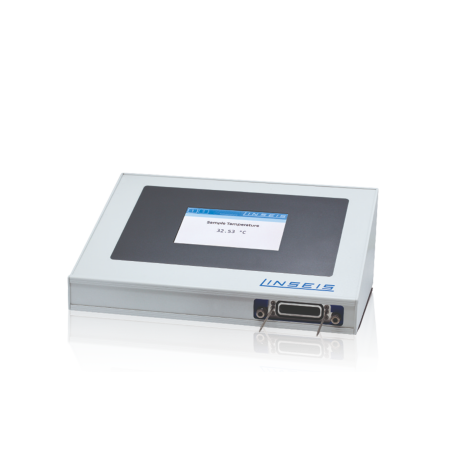
Thermoelectric Material Measurement System — LSR-1 (LSR L32)
1. Instrument Overview
The LSR-1 is a professional thermoelectric material characterization system designed for simultaneous measurement of the Seebeck coefficient and electrical resistivity / conductivity. The standard operating temperature range is from room temperature up to 200°C, with optional extensions to low temperature down to −160°C or high temperature up to 600°C. The system supports vacuum, inert, reducing, and oxidizing atmospheres, making it suitable for a wide range of material research applications. Its compact benchtop design combined with automated control software ensures high usability and stable operation.
2. Measurement Principles
1. Seebeck Coefficient
- The Seebeck coefficient is determined by applying a controlled temperature difference (ΔT) across the sample and measuring the corresponding thermoelectric voltage.
- Linear regression of voltage versus temperature difference is used to calculate the Seebeck coefficient, with a typical measurement time of 30–90 seconds.
- A dual-point temperature and voltage measurement scheme is applied to effectively reduce drift errors.
2. Electrical Resistivity / Conductivity
- The Van der Pauw four-probe method is used, allowing measurement of irregular-shaped bulk samples or thin films.
- Two measurement cycles are performed by alternating current and voltage contacts, and the sheet resistance is calculated using standard equations.
- Bulk resistivity and electrical conductivity are then derived from the measured values.
3. System Features and Advantages
- Simultaneous dual-property measurement: Seebeck coefficient and electrical resistivity are measured at the same time, ensuring high data consistency.
- Modular architecture: Optional modules include low-temperature cooling, gas control, optical windows, and illumination units.
- Sealed chamber design: Supports vacuum operation and flexible switching between different gas atmospheres.
- Fully automated measurement software: Provides data quality checks, graphical analysis, and export to Excel or ASCII formats.
- Benchtop design: Enables easy sample mounting and fast experimental workflow.
4. Key Technical Specifications
- Temperature range: RT ~ 200°C (optional: −160°C ~ 600°C)
- Seebeck measurement range: 0 ~ 2.5 mV/K
- Maximum temperature difference ΔT: ≤ 10 K
- Thermoelectric voltage range: ±8 mV, resolution 0.5 nV
- Sample size (Seebeck): L 8–25 mm / W 2–25 mm / thickness ≤ 2 mm
- Sample size (resistivity): L/W 18–25 mm / thin film up to 2 mm
- Minimum resistance range: 10 nΩ
- Heating rate: 0.01–100 K/min
- Temperature accuracy: ±1.5°C or 0.0040 × |T|
5. Application Fields
- Thermoelectric performance studies of metals, semiconductors, and composite materials.
- Material development and efficiency evaluation from low to medium-high temperatures.
- Material optimization, grain boundary engineering, thin-film processing, and composition tuning.
- R&D, quality control, and structure–property correlation studies.
Video: LSR-1 Demonstration Video (YouTube)
Mobile: 0919-138-108
Email: Allen.kuo@fstintl.com.tw