

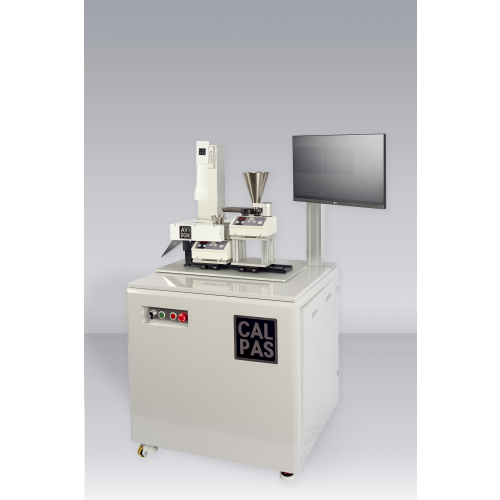
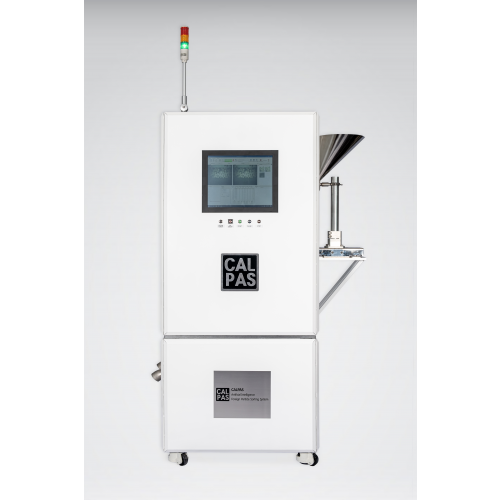
Foreign Particle & Color Inspection and Automated Sorting Systems for Powders and Granules
This system integrates high-precision optical imaging with artificial intelligence (AI)–based image analysis technology. It enables high-speed detection of foreign particles, color defects, damage, and other surface imperfections in powder, granular, liquid, and thin-sheet samples, combined with automated classification and rejection modules. The system is particularly suitable for applications with stringent cleanliness and appearance requirements, such as lithium battery materials, food powders, 3D printing materials, plastic pellets, and fine chemical products.
Key Functions and Application Configurations
Depending on production-line or laboratory requirements, the system can be configured into multiple inspection and sorting solutions:
- Powder Sorting System: Detection and removal of foreign particles and color variations in powder raw materials.
- Liquid Inspection System: Suitable for foreign particle detection in suspensions, slurries, and liquid samples.
- Thin-Sheet Inspection System: Inspection of surface contamination, scratches, and color defects on films and sheets.
- Optical Granule Sorting: Detection of size, appearance, and color defects at the granule level.
- Color Deviation and Defect Inspection: Automatic identification of off-color particles and surface defects.
- Lithium Battery Material Contamination Analysis: Foreign particle detection in cathode/anode materials and conductive additives.
- Pharmaceutical Powder Inspection: High-standard cleanliness and appearance control for pharmaceutical-grade powders.
- Automated Color Sorting Equipment: Rapid separation of particles or powders based on color differences.
The system supports both in-line automated optical inspection and laboratory-based optical inspection solutions. It significantly improves inspection accuracy and sorting capability while increasing inspection efficiency and overall production throughput.
Core Features of the CALPAS Foreign Particle Analysis System
1. Artificial Intelligence and Deep Learning Technology
- Utilizes deep learning algorithms to accurately distinguish foreign particles from non-defects (e.g., shadows or normal textures), effectively reducing false detection rates.
- Features automatic learning and sample matching functions, achieving inspection accuracy comparable to or exceeding manual visual inspection.
2. Multi-Directional Illumination and Dual-Side Inspection
- Unique 5–6-directional illumination design with independent intensity control for each light source, minimizing shadow-related blind spots.
- Supports simultaneous top and bottom inspection and sorting, ensuring comprehensive and reliable detection.
3. Broad Sample Compatibility and High-Resolution Detection
- Supports a wide range of sample types, including transparent or opaque granules, powders, and wet suspension samples.
- Capable of detecting micro-scale foreign particles down to approximately 10 μm, suitable for optical, medical, and high-specification products.
- Provides extended depth-of-focus performance, maintaining sharp imaging and stable inspection quality over a wide focal range.
4. Automation and Data Management Capabilities
- Supports automated weighing, standardization functions, and optional automatic sample loading to improve operational efficiency.
- Equipped with RS232, RS485, and Ethernet communication interfaces for seamless integration with production equipment and supervisory systems.
- Analysis results are stored on the system PC and can be shared with client PCs via network; report formats and data outputs are customizable based on user requirements.
5. Advantages over Conventional Inspection Methods
- Compared with manual visual inspection, the system eliminates errors caused by operator fatigue and subjective judgment.
- Compared with conventional equipment, it reduces inspection blind spots caused by shadows, sample rotation, or orientation changes.
- AI-based analysis combined with multi-directional illumination enhances overall inspection stability and result reproducibility.
Typical Application Fields and Case Examples
Primary Application Areas
- Polymer materials and plastic pellet inspection
- Ceramic powders and precursor material quality control
- Pharmaceutical powders and granule appearance inspection
- Fine chemicals and functional powder contamination monitoring
- Environmental engineering particle and suspension analysis
Case Example (System Operation Overview)
- Plastic powder samples are fed into the upper hopper (capacity up to approximately 5 L). Vibration, air flow, and rotary feeding mechanisms ensure stable transport into the inspection zone.
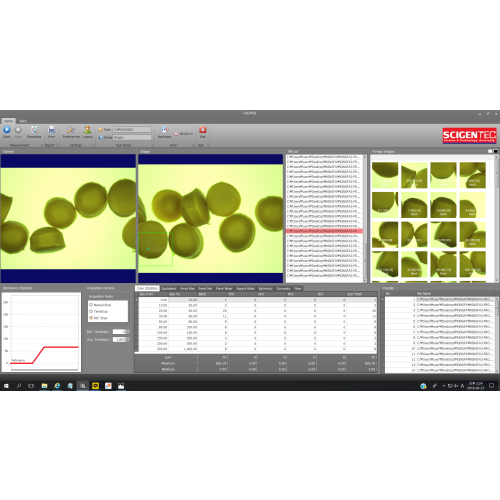
- Up to five illumination units and five color cameras can be configured for synchronized image capture. The minimum camera resolution reaches approximately 5 μm for micro-particle detection.
- Dedicated software allows users to define contaminant size ranges and color criteria to meet specific production or quality standards.
- RS232, RS485, or Ethernet interfaces enable easy integration with automated production lines and supervisory control systems.
- Depending on system configuration and sample characteristics, processing capacity can reach up to approximately 60 kg/h while maintaining high inspection accuracy.
- Inspection results are stored on the system PC and can be shared with client PCs via network, with report formats customizable to user needs.
- An AI-based analysis module performs advanced defect classification and pattern recognition for stable and precise inspection and sorting.
- An optional movable rail illumination module supports large-area scanning and inspection of films or plastic products.
Mobile: 0919-138-108
Email: Allen.kuo@fstintl.com.tw