
Metals & Alloys Industry Applications|Melting Behavior, Thermal Expansion, and Thermal Conductivity Measurement
Metals and alloys are key materials in modern industry and technology. From steels, aluminum alloys, and nickel-based superalloys to low-expansion alloys and high-thermal-conductivity materials, their performance is highly dependent on precise composition control and thermal processing history. Through thermal analysis and thermophysical property measurements, melting, solidification, and in-service thermal behavior can be reproduced under laboratory conditions, supporting material development, process optimization, and quality assurance.
Why Are Thermal Analysis and Thermophysical Measurements Important for Metals & Alloys?
Alloys are metallic materials composed of at least two elements, one of which is a metal. Alloying can significantly modify mechanical and thermal properties such as strength, hardness, corrosion resistance, and coefficient of thermal expansion. These properties strongly depend on composition, melting and solidification conditions, and subsequent heat-treatment processes. Thermal analysis and thermophysical measurements enable rapid acquisition of key parameters from small samples that are highly relevant to real manufacturing processes.
- Melting point and solidus/liquidus lines: fundamental data for casting, welding, and heat-treatment design.
- Phase transformations and heat-treatment behavior: observation of heat flow and structural changes during annealing, aging, and martensitic transformations.
- Thermal expansion and dimensional stability: evaluation of dimensional matching for assemblies, packaging, and precision components.
- Thermal conductivity and specific heat: essential parameters for high-temperature components, heat-sink structures, and heat-exchanger design.
- Quality control and batch consistency: establishment of “thermal fingerprints” for incoming inspection and process monitoring.
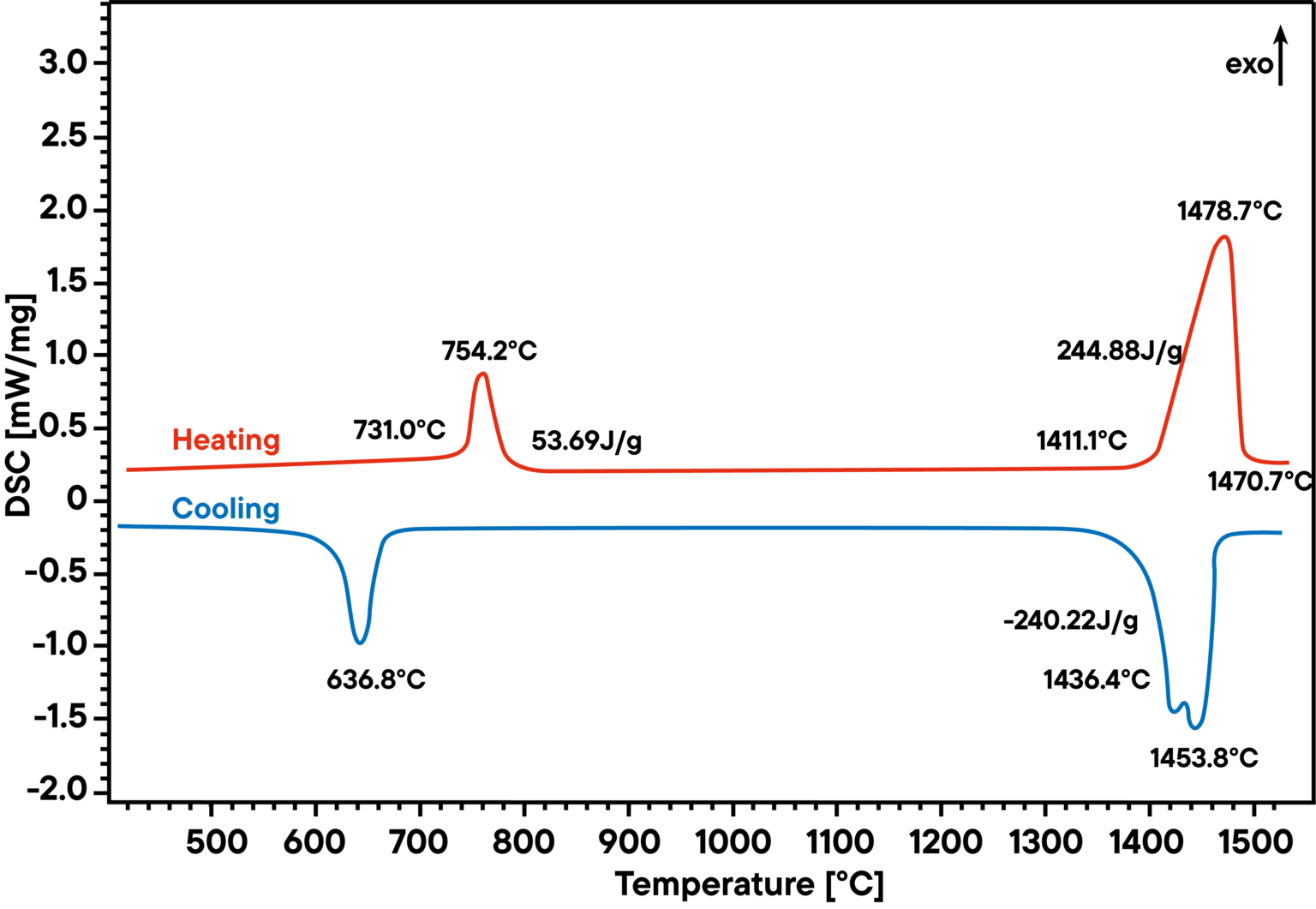
Application Case 1: Analysis of Melting, Solidification, and Phase Transformations in Metals & Alloys (DSC / STA)
In the development and quality control of steels and high-temperature alloys, accurate determination of melting points, solidus/liquidus temperatures, and phase-transformation temperatures is critical. Differential Scanning Calorimetry (DSC) and Simultaneous Thermal Analysis (STA: TGA + DSC) enable controlled-atmosphere measurement of melting and solidification, as well as observation of eutectic reactions, precipitation, and recrystallization.
Key Measurement & Interpretation Points:
- Melting and solidification peaks: determination of solidus/liquidus temperatures and enthalpy of fusion.
- Solid-state phase transformations: austenite/ferrite transformations, precipitation hardening, and recrystallization ranges.
- Alloy composition comparison: evaluation of the effect of alloying elements on melting and transformation behavior.
These results are directly applicable to alloy design, casting, and heat-treatment optimization, and serve as objective criteria for incoming inspection and batch release.
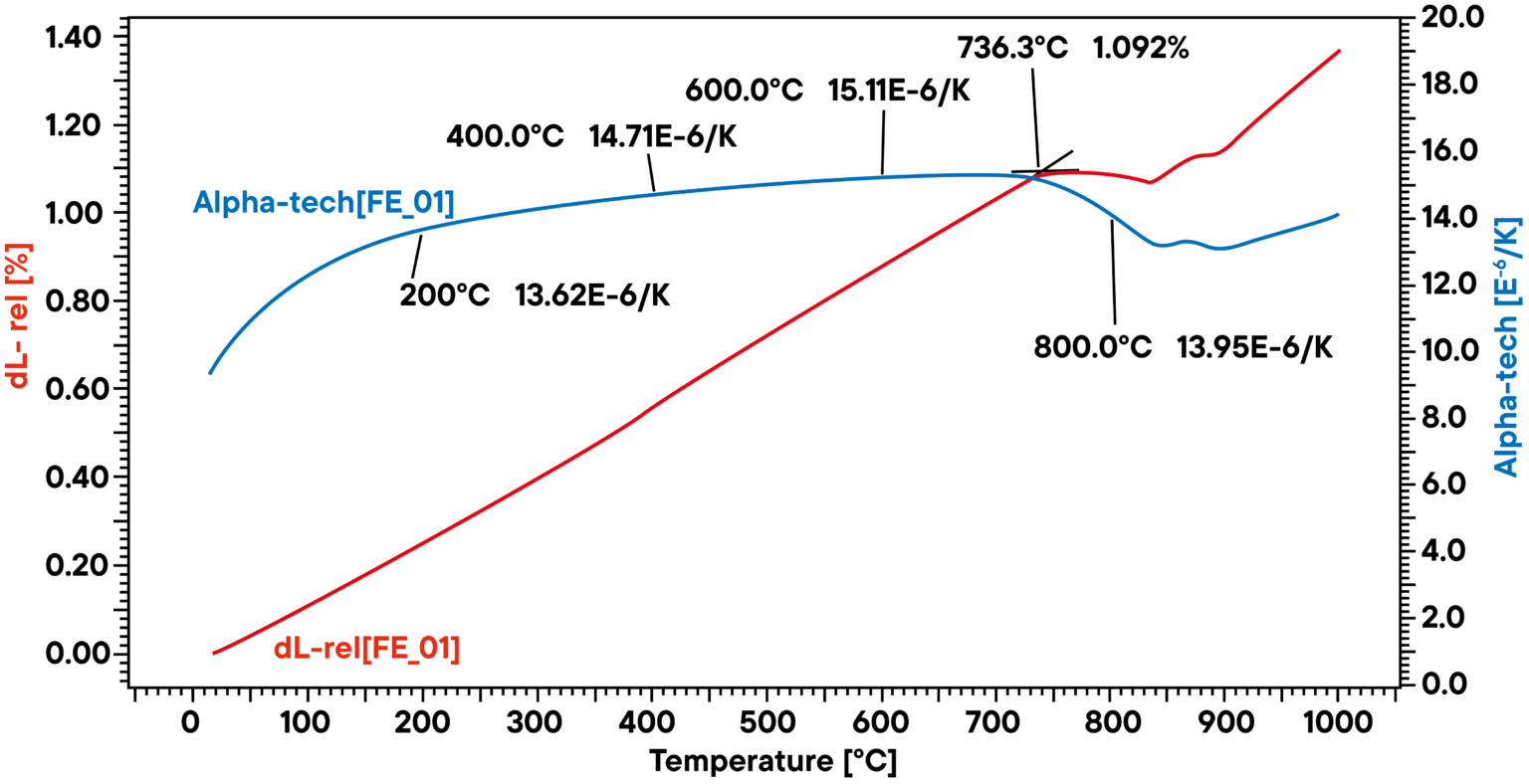
Application Case 2: Evaluation of Thermal Expansion and Phase-Transformation Strain in Alloys (DIL)
In tool steels, welded structures, electronic packaging, and low-expansion alloys, the coefficient of thermal expansion (CTE) and phase-transformation-induced volume changes directly affect dimensional accuracy and thermal stress. Using a dilatometer, expansion curves from room temperature to high temperature can be obtained, enabling analysis of martensitic transformations, precipitation, and other phase changes.
Key Measurement & Interpretation Points:
- Coefficient of thermal expansion: comparison among different steels, Fe–Ni low-expansion alloys, and aluminum alloys.
- Phase-transformation temperatures and volume changes: identification via slope changes and discontinuities in expansion curves.
- Heat-treatment deformation control: simulation of quenching, tempering, and isothermal annealing to predict dimensional change and residual stress risk.
For high-precision fixtures, components, and packaging structures, these thermal-expansion data are essential for design and material selection.
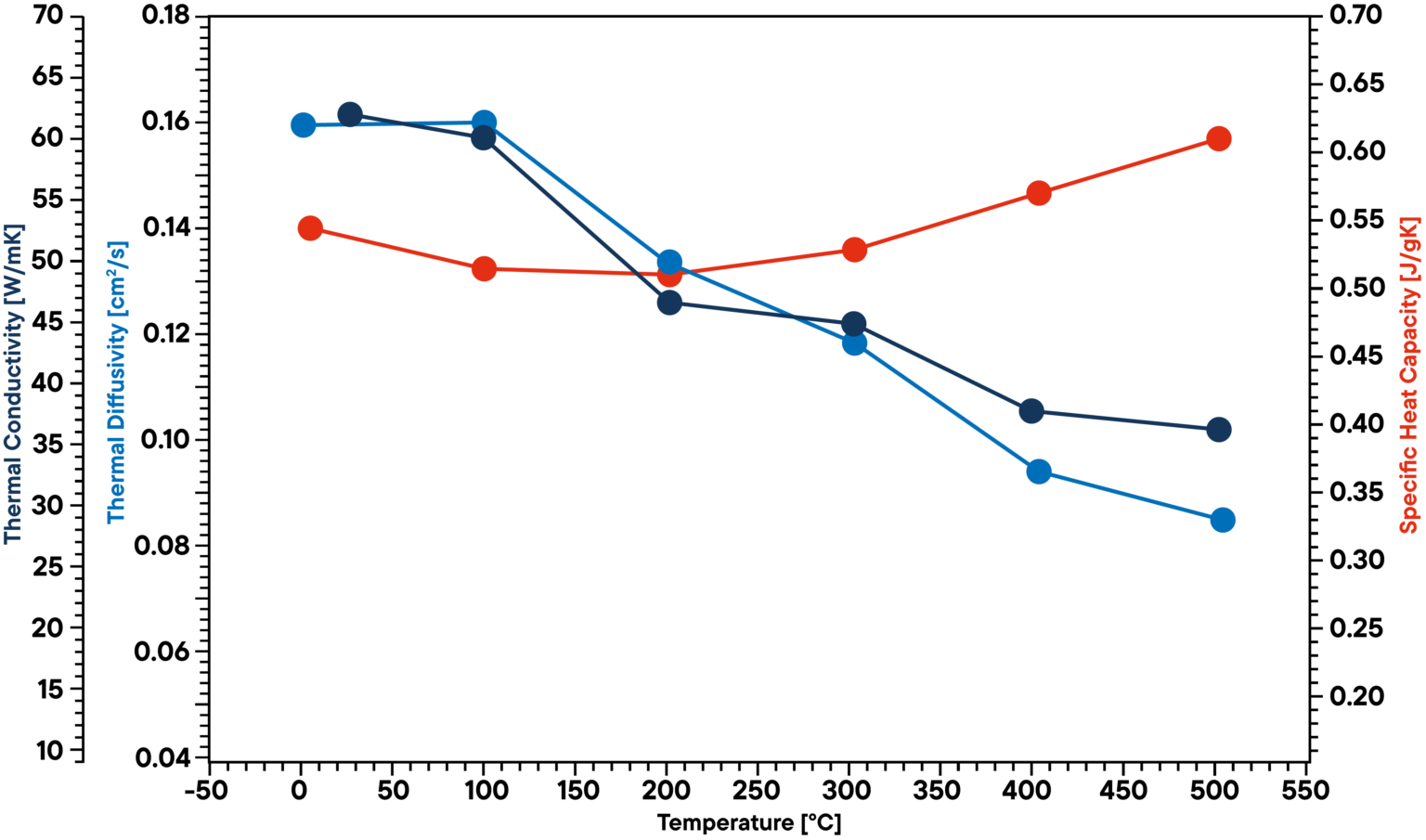
Application Case 3: Measurement of Thermal Conductivity, Thermal Diffusivity, and Specific Heat of Metals & Alloys (LFA / THB)
In automotive, aerospace, and high-power electronics applications, aluminum alloys, copper alloys, and high-thermal-conductivity metals are widely used as heat-spreader substrates, heat exchangers, and structural components. Their thermal conductivity and specific heat vary with temperature and alloy composition, directly affecting thermal management and temperature uniformity. Laser Flash Analysis (LFA) and transient hot-wire/bridge techniques (e.g., THB) provide temperature-dependent thermal diffusivity and specific heat, from which thermal conductivity can be calculated.
Key Measurement & Interpretation Points:
- Thermal conductivity vs. composition: comparison of different aluminum and copper alloy formulations.
- Temperature dependence: establishment of thermal diffusivity and Cp curves over operating ranges such as 25–500 °C.
- Heat-dissipation capability and safety margin: evaluation of thermal transport under extreme conditions such as thermal shock and localized overheating.
These thermophysical data provide quantitative support for heat-exchanger design, electronic module cooling, and thermal management strategies of high-temperature structures.
Common Thermal Analysis & Thermophysical Measurement Techniques for Metals & Alloys
- Differential Scanning Calorimetry (DSC): measurement of melting points, solidus/liquidus lines, phase transformations, and precipitation reactions.
- Simultaneous Thermal Analysis (STA: TGA + DSC): simultaneous acquisition of mass change and heat-flow signals for oxidation and reaction studies.
- Thermal expansion measurement (DIL / TMA): determination of CTE and phase-transformation-induced dimensional changes.
- Thermal conductivity and diffusivity measurement (LFA, THB, HFM): characterization of heat-transfer properties of bulk and sheet metals.
- Specific heat capacity (Cp): essential thermodynamic input for heat-balance calculations and thermal-process simulation.
Based on actual application scenarios such as casting, forging, heat treatment, thermal management, and high-temperature structural components, we provide customized measurement solutions, trial testing, and technical support to assist material development, process optimization, and quality control.
Need a Thermophysical or Electrical Property Evaluation Solution?
We provide measurement services, technical consulting, and project collaboration to help improve R&D efficiency and product reliability.
Allen Kuo|FST International|Email: Allen.kuo@fstintl.com.tw