
Building Materials Applications|Thermal Analysis and Thermophysical Property Measurements for Construction Materials
From cement, gypsum, and mortars to high-performance insulation materials and road asphalt, construction materials must simultaneously meet requirements for safety, durability, and energy efficiency. Through thermal analysis and thermophysical property measurements, material behavior under heating, cooling, and long-term environmental exposure can be accurately characterized during R&D and quality control, reducing structural risks and supporting optimized energy-efficient building design.
Why Do Construction Materials Require Thermal Analysis and Thermophysical Property Measurements?
In real-world use, construction materials experience day–night temperature swings, seasonal variation, and potentially high-temperature fire exposure. Thermal analysis and thermophysical property measurements enable early-stage evaluation of material stability and reliability under different conditions during design and material selection.
- Compliance with regulations and standards: Verification of construction materials against fire resistance, heat resistance, insulation, and related requirements.
- Structural and safety assessment: Observation of high-temperature decomposition, mass loss, and phase transitions to predict performance under fire or thermal shock scenarios.
- Weathering and lifetime prediction: Simulation of thermal cycling, diurnal temperature variation, and long-term aging behavior for service life assessment.
- Energy-saving and insulation design: Optimization of wall, roof, and insulation systems via thermal conductivity and U-value measurements.
- Process and formulation optimization: Comparison of the effects of formulations, moisture content, and filler ratios on final material performance.
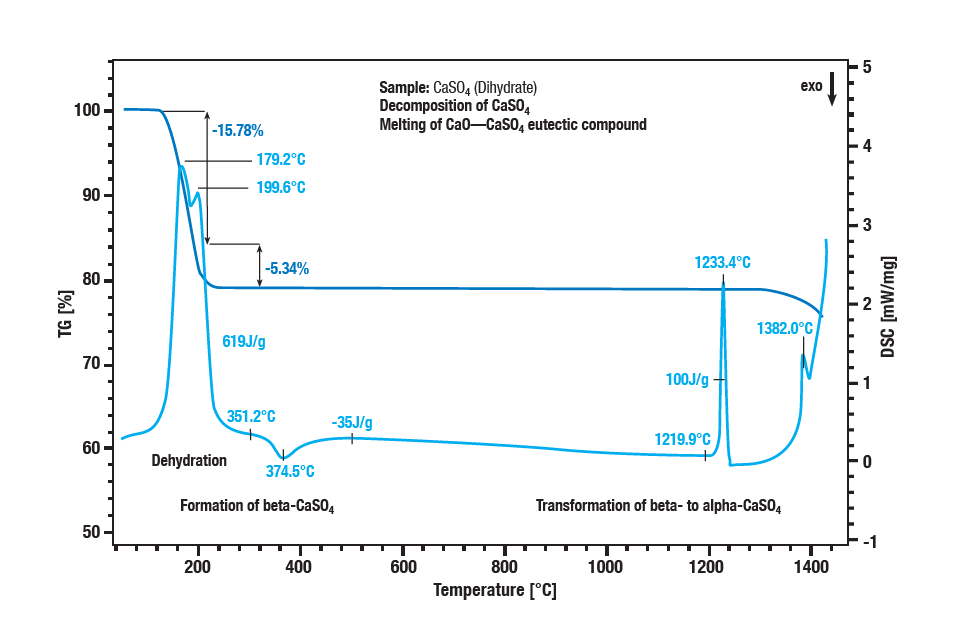
Application Case 1: Dehydration and Phase Transition Analysis of Gypsum Construction Materials (STA / TG-DSC)
Gypsum (calcium sulfate dihydrate) is widely used in gypsum boards, finishing layers, and partition systems. With simultaneous thermal analysis (TGA coupled with heat flow signals), dehydration processes and polymorphic transitions can be comprehensively characterized, enabling comparison among different sources and formulations.
Typical thermal behavior:
- Approximately 100–300 °C: Progressive dehydration from dihydrate to hemihydrate, followed by conversion to anhydrous calcium sulfate.
- Approximately 340 °C: An exothermic peak corresponding to a polymorphic transition of anhydrous calcium sulfate.
- Above approximately 1200 °C: Further decomposition and formation of new oxide phases.
These results can be used to establish a “thermal stability fingerprint” for gypsum-based construction materials, supporting quality verification, formulation adjustment, and fire-rating evaluation.
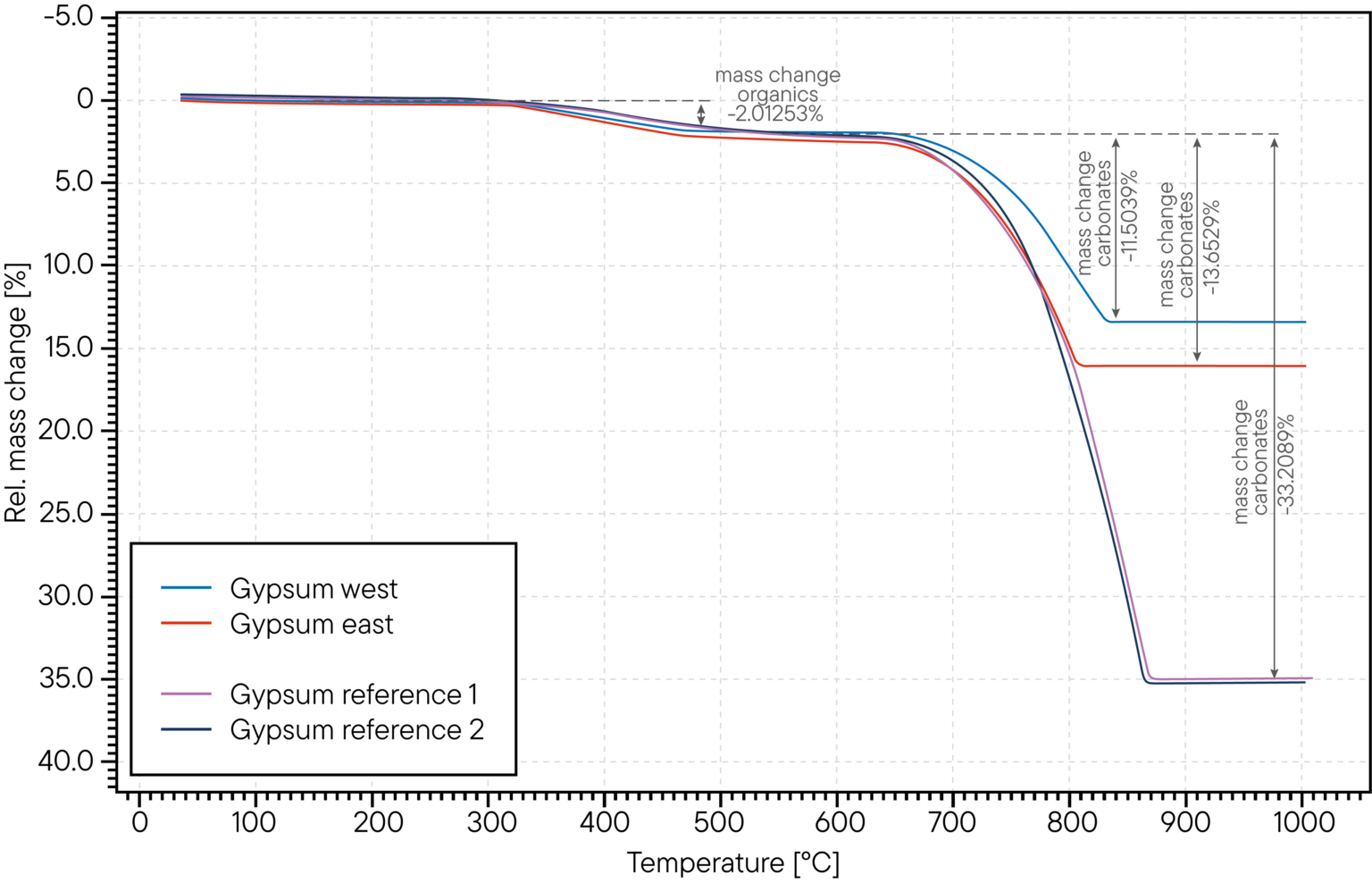
Application Case 2: Failure Analysis of Cracking in Gypsum Wall Finishing Layers (TGA)
After experiencing summer–winter temperature cycling, gypsum finishing layers in some buildings may develop cracks or local delamination. Using thermogravimetric analysis (TGA), samples from “undamaged areas” and “cracked areas” can be compared to evaluate whether formulation ratios or raw-material differences are likely root causes.
Measurement and analysis focus:
- Mid-temperature mass loss: Associated with organic additives and bound water content, reflecting construction additives and moisture conditions.
- High-temperature mass loss (approximately 800–900 °C): Associated with carbonate content; significant differences may indicate inconsistent raw materials or mixing ratios.
This approach is commonly used for construction material failure investigations and can serve as an objective basis for workmanship disputes and quality audits.
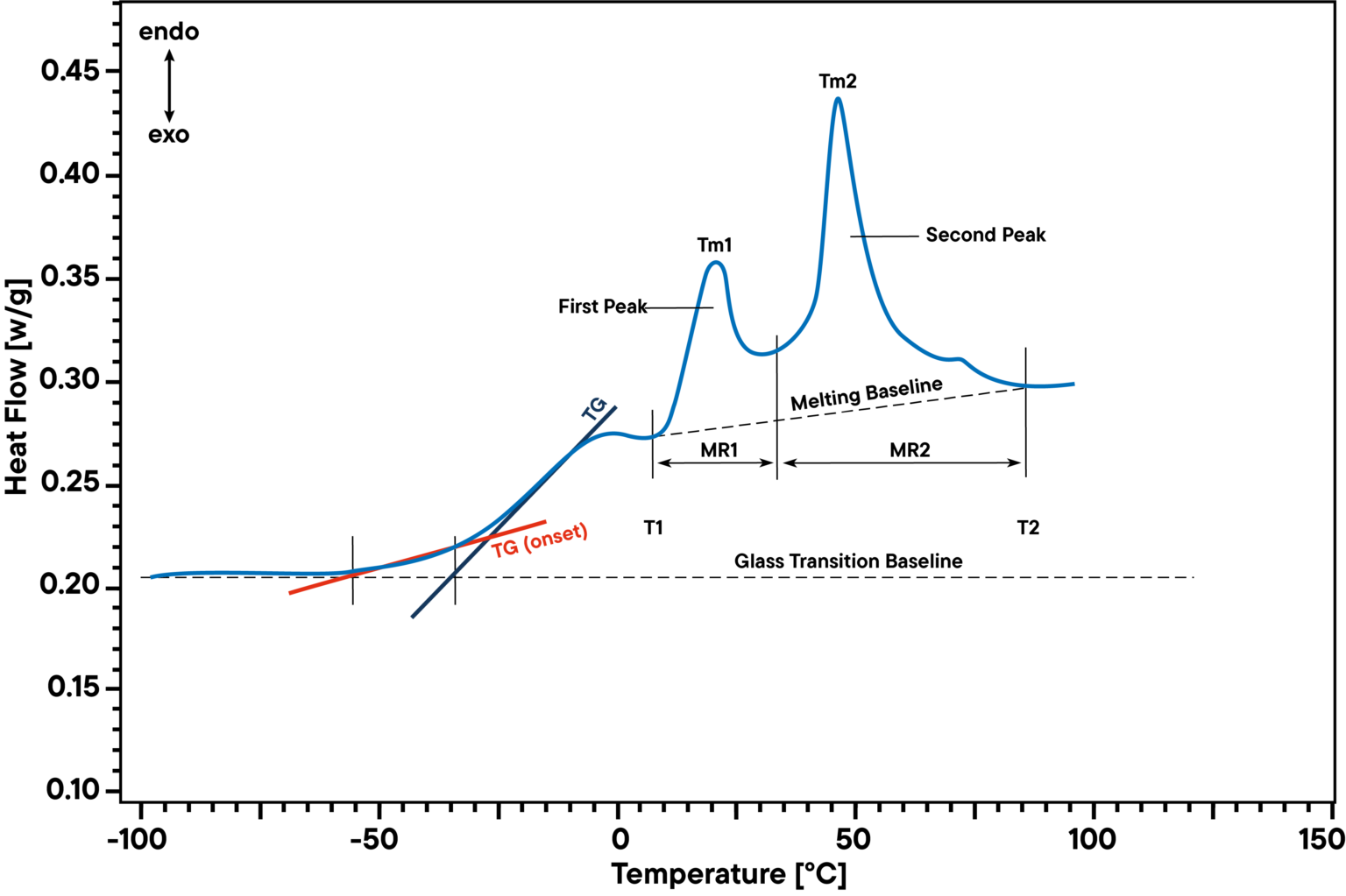
Application Case 3: Glass Transition Temperature of Road Asphalt and Waterproofing Materials (DSC)
Road asphalt and related waterproofing materials may become brittle at low temperatures and soften or deform at high temperatures. Differential scanning calorimetry (DSC) measures glass transition temperature (Tg) and melting-related thermal effects, supporting evaluation of material suitability across different climate conditions.
Evaluation directions supported:
- Formulation selection and comparison for pavement materials under cold-climate and hot-climate conditions.
- Differences in Tg and thermal stability between polymer-modified asphalt and conventional asphalt.
- Low-temperature cracking risk assessment for waterproof membranes and roof-coating materials.
Overview of Common Thermal Analysis and Thermophysical Property Measurement Techniques for Building Materials
- Simultaneous thermal analysis (TGA + DSC): Dehydration, decomposition, and phase transition analysis of cement, gypsum, mortars, and composite construction materials.
- Thermogravimetric analysis (TGA): Estimation of organic content, fillers, carbonates, and failure diagnosis.
- Differential scanning calorimetry (DSC): Evaluation of glass transition temperature, melting behavior, and crystallinity.
Based on real construction-material application scenarios, we assist in planning appropriate measurement methods and test conditions, and provide feasibility testing and technical support services.
Do You Need Material Thermophysical Property Evaluation Solutions?
We provide measurement services, technical consulting, and project collaboration to help you improve R&D efficiency and product reliability.
Allen Kuo|FST International|Email: Allen.kuo@fstintl.com.tw