
Cosmetics, Pharmaceuticals, and Food Applications|Formulation Stability and Thermophysical Property Measurements
Many pharmaceutical ingredients and cosmetic emulsions are highly sensitive to temperature; even slight heating may cause decomposition, oil–water separation, or oxidative degradation. Cold-chain pharmaceuticals and food products may suffer reduced shelf life or quality loss if temperature limits are exceeded, even briefly. Through thermal analysis and thermophysical property measurements, the thermal behavior of active ingredients and excipients can be thoroughly characterized, supporting robust formulation design, process optimization, and packaging protection strategies.
Why Do Cosmetics, Pharmaceuticals, and Food Products Require Thermal Analysis and Thermophysical Property Measurements?
In cosmetics, pharmaceuticals, and food applications, products are often complex formulation systems, such as creams, suspensions, powders, or glassy solids. During transportation, storage, and actual use, these formulations are subjected to temperature fluctuations and long-term aging. Without a thorough understanding of their thermal stability and phase behavior, products may experience potency loss, texture or sensory changes, or even safety risks.
- Pharmaceutical potency and stability: Evaluation of decomposition and glass transition behavior of active ingredients and excipients under heating or long-term storage.
- Cold-chain risk management: Establishment of degradation and quality indicators for pharmaceuticals and foods exposed to temperature excursions.
- Cream and lotion texture control: Observation of melting behavior of fats and waxes in emulsion systems to maintain desirable sensory properties and appearance stability.
- Food formulation and sensory design: Comparison of thermal parameters such as fat composition and sugar glass transition to optimize flavor and mouthfeel.
- Packaging and process design: Use of thermal conductivity and specific heat measurements to support heating/cooling conditions and insulated packaging design.
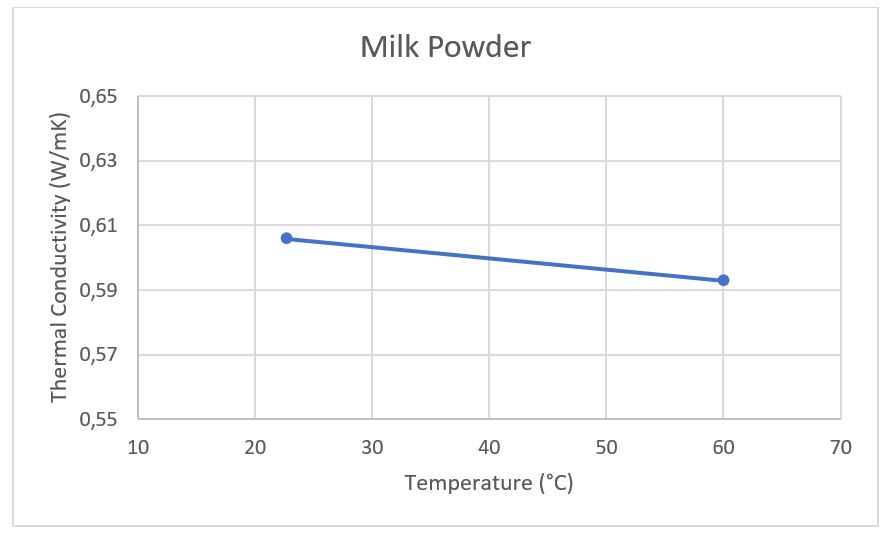
Application Case 1: Thermal Conductivity Evaluation of Milk Powder During Transportation and Storage (Transient Hot Bridge)
During transportation and warehouse storage, milk powder is often exposed to significant ambient temperature variations. The thermal conductivity and specific heat of the powder influence the rate of heat transfer and temperature uniformity within bulk stacks, thereby affecting quality stability and flavor preservation.
Measurement and analysis focus:
- Thermal conductivity and specific heat: Ideal products tend to exhibit higher specific heat and lower thermal conductivity to reduce the impact of temperature fluctuations.
- Formulation-related factors: Composition, bulk density, porosity, fat content, and moisture level all influence the thermophysical properties of milk powder.
- Experimental condition settings: Thermal conductivity can be compared at room temperature and elevated temperatures (e.g., 60 °C) to simulate real transportation scenarios.
Transient hot bridge (THB) measurements establish thermophysical property databases for milk powder and other dried food powders, serving as a basis for cold-chain design and insulated packaging selection.
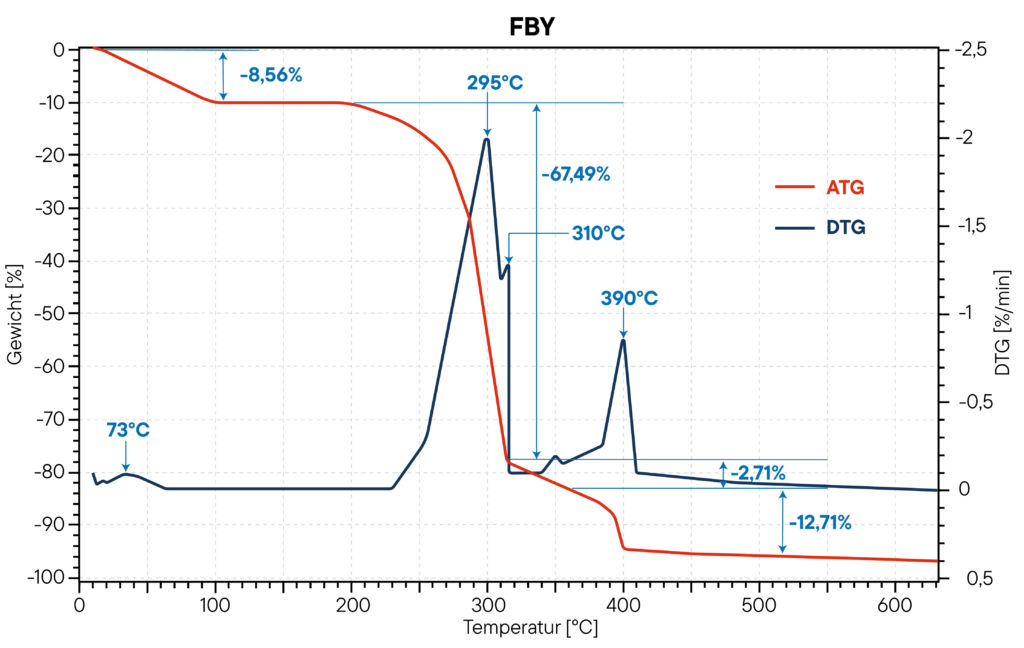
Application Case 2: Thermal Behavior Analysis of Agricultural By-Products such as Banana Pseudostem (STA)
Agricultural by-products such as banana pseudostems can be utilized as fiber materials, fillers, or bioenergy feedstocks. Through simultaneous thermal analysis (STA: TGA + DSC), dehydration, thermal decomposition, and residue formation behaviors can be systematically characterized, supporting evaluation of suitability for drying, carbonization, or other thermal treatment processes.
Measurement and analysis focus:
- Low-temperature mass loss: Associated with free and bound water release, closely related to drying process design.
- Mid- to high-temperature decomposition steps: Differentiation of thermal decomposition ranges of hemicellulose, cellulose, and lignin components.
- Residual carbon content: A key parameter for applications as carbon materials or fuels.
Such analyses provide practical reference for developing reuse pathways for food-industry by-products, including fiber reinforcement and functional powder applications.
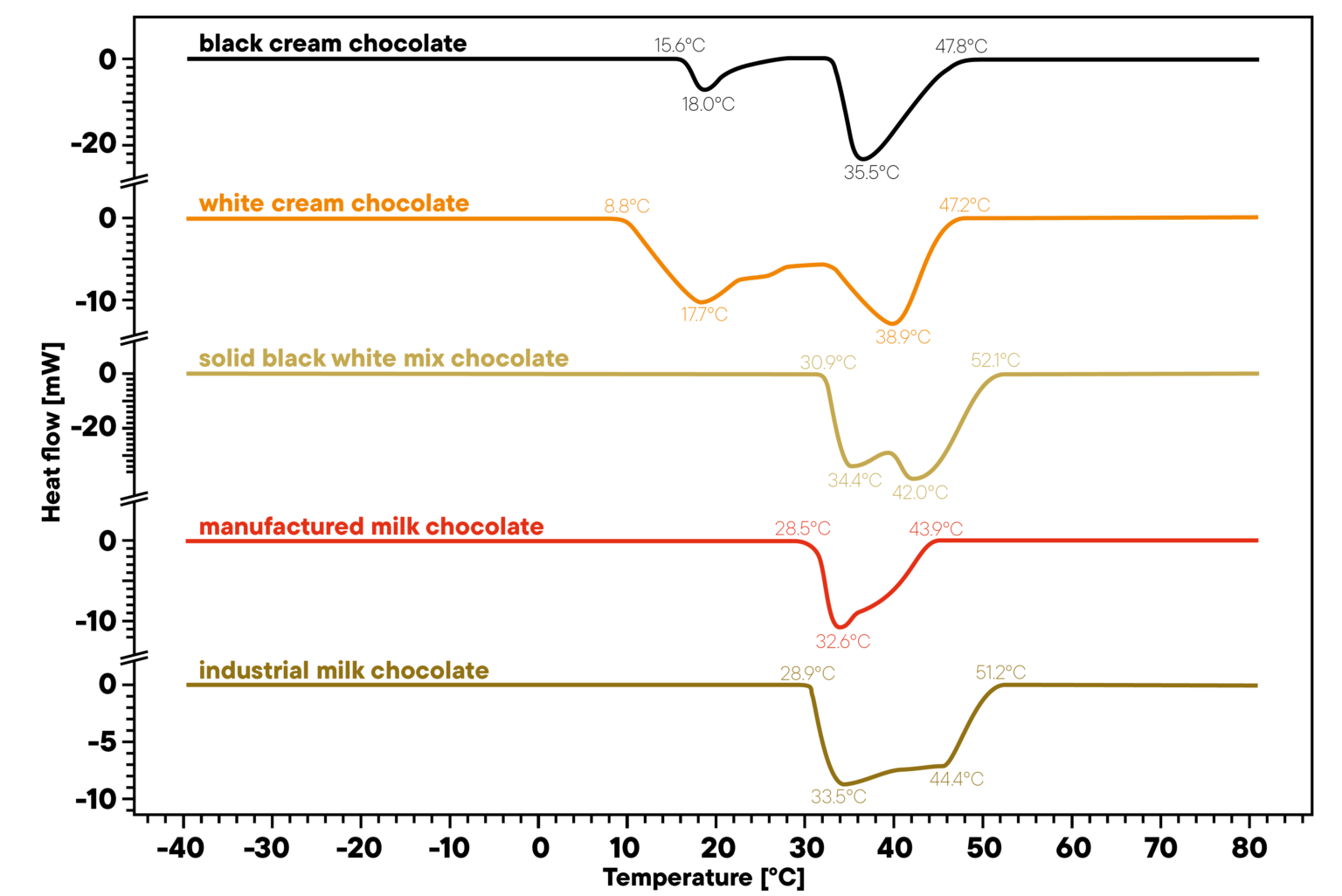
Application Case 3: Melting Behavior and Fat Composition Analysis of Chocolate Formulations (DSC)
Differential scanning calorimetry (DSC) is widely used in quality control of chocolate and related food products. By analyzing melting curves, differences in fat composition, crystalline structure, and emulsification quality can be evaluated and correlated with mouthfeel, melt-in-the-mouth behavior, and storage stability.
Measurement and analysis focus:
- Dual or multiple melting peaks: Corresponding to the proportion of low-melting milk fats and higher-melting vegetable fats.
- Peak position and area: Indicators of fat type, content, and crystalline structure differences.
- Artisanal vs. mass-produced chocolate: Differences in melting uniformity and peak shape are often observed.
These DSC data support new formulation development, process optimization, and batch-to-batch quality consistency evaluation.
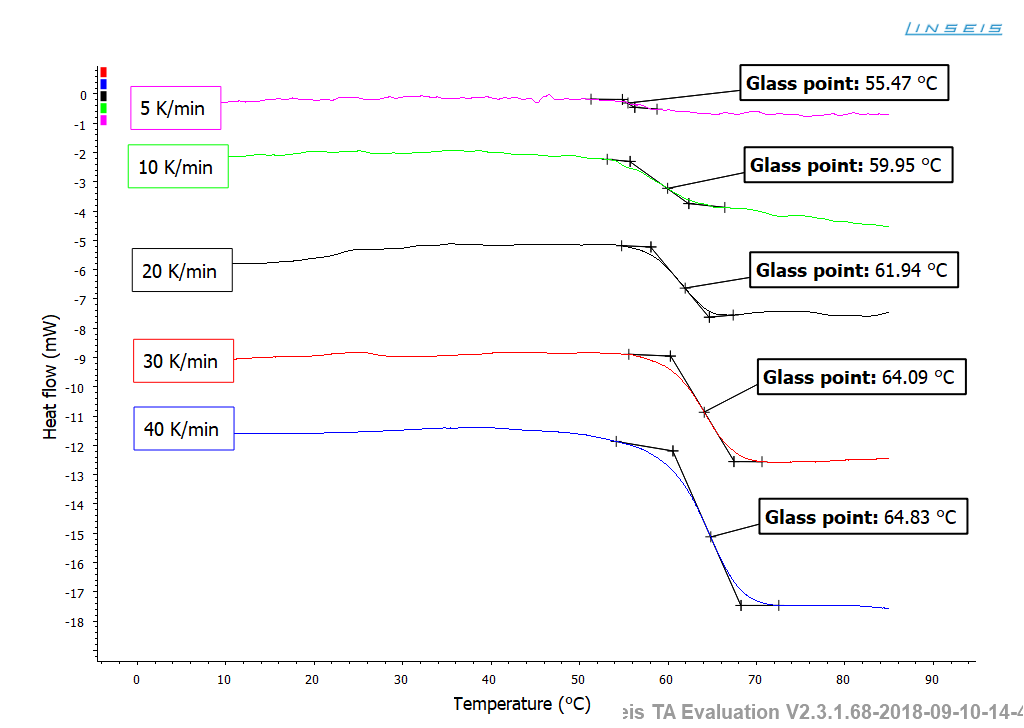
Application Case 4: Glass Transition Temperature and Polymorphism Analysis of Lactose and Pharmaceutical Excipients (DSC)
Lactose and polyols (such as sorbitol) are commonly used as excipients or sweeteners in pharmaceuticals and nutraceuticals. Transitions between glassy and crystalline states affect flowability, compressibility, and moisture stability. DSC enables accurate measurement of glass transition temperature (Tg) and melting behavior, supporting polymorphic identification.
Measurement and application focus:
- Relationship between Tg and storage temperature: When storage temperature approaches or exceeds Tg, caking or property changes are more likely to occur.
- Glassy vs. crystalline states: Evaluation of stability windows for spray-dried powders and solid dispersion systems.
- Polymorphism identification: Determination of the presence and proportion of different crystal forms based on melting peak position and enthalpy.
For pharmaceuticals, nutraceuticals, and infant formula products, such thermal analysis results form a critical basis for formulation and process design.
Overview of Common Thermal Analysis and Thermophysical Property Measurement Techniques for Cosmetics, Pharmaceuticals, and Food
- Differential scanning calorimetry (DSC): Measurement of glass transition temperature, melting and crystallization behavior, polymorphism, fat melting curves, and reaction enthalpy.
- Thermogravimetric analysis (TGA) and simultaneous thermal analysis (STA: TGA + DSC): Evaluation of moisture content, volatiles, and thermal decomposition behavior for powders, dried foods, and excipients.
- Thermal conductivity and thermal diffusivity measurements (e.g., THB, LFA, HFM techniques): Determination of heat transfer properties of powders, liquids, and packaging systems for cold-chain and temperature-control design.
- Specific heat capacity (Cp) measurement: Providing thermodynamic parameters required for energy balance and heating/cooling time calculations.
- Thermomechanical and expansion measurements (TMA / DIL): Evaluation of dimensional stability and compatibility of packaging and structural materials under temperature variation.
Based on real application scenarios in cosmetics, pharmaceuticals, or food, we assist in planning appropriate measurement methods and test conditions, and provide feasibility testing and technical consulting services as essential tools for formulation development, process optimization, and quality assurance.
Do You Need Thermophysical or Electrical Property Evaluation Solutions?
We provide measurement services, technical consulting, and project collaboration to help you improve R&D efficiency and product reliability.
Allen Kuo|FST International|Email: Allen.kuo@fstintl.com.tw