

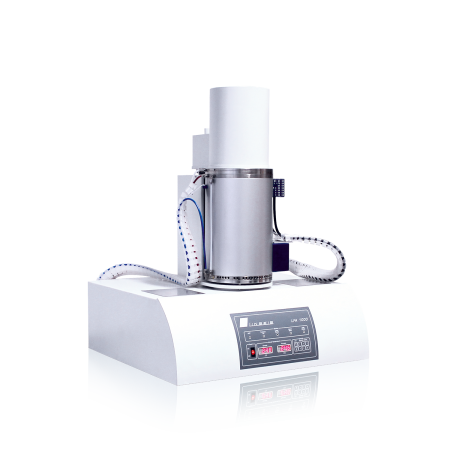
LFA 500 Light / Laser Flash: High-Accuracy Thermal Property Measurement Solution for a Wide Range of Materials
The LFA 500 Light Flash and Laser Flash series provide efficient thermal property analysis capabilities. Up to 18 samples can be measured in a single run, while key parameters such as thermal diffusivity, thermal conductivity, and specific heat capacity (cp) are obtained simultaneously.
As industrial demands for thermal management and heat transfer design continue to increase, reliable thermal property data have become essential for optimizing heat conduction performance in final products. Over the past decades, the flash method has evolved into one of the most widely used techniques for measuring thermal diffusivity and thermal conductivity of solids, powders, and liquids.
This instrument series combines high accuracy with excellent application flexibility, making it an ideal standard platform for thermal conductivity analysis.
Key Features
- Measurement of thermal conductivity in both through-plane and in-plane directions.
- Comprehensive thermal property analysis including thermal diffusivity, thermal conductivity, and specific heat capacity.
- Up to 18 samples can be measured simultaneously (depending on configuration).
- Compliant with multiple international standards: ASTM E1461, ASTM E2585, DIN 30905, DIN EN 821, and others.
- Suitable for solids, powders, liquids, pastes, thin films, and various sample forms.
LFA 500 Measurement Principle
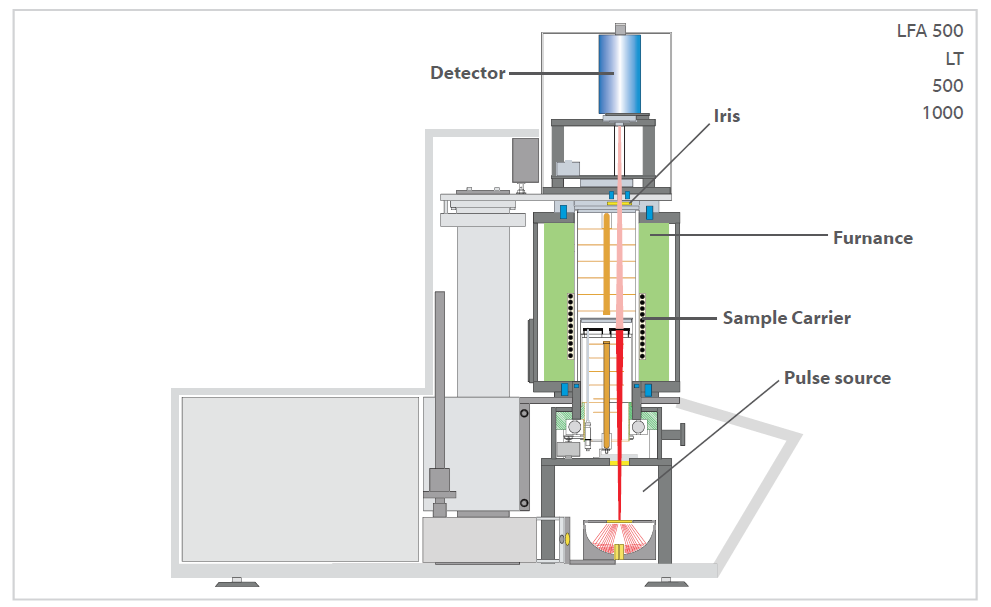
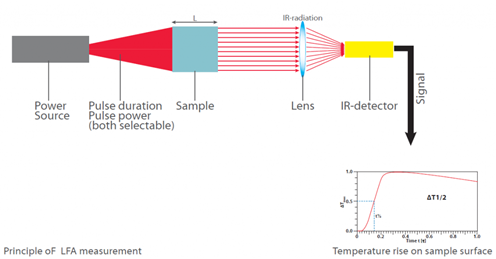
The sample is placed on a sample holder and surrounded by the furnace (LFA 500-LT / 500 / 1000 and other configurations). During measurement, the furnace is controlled at a preset temperature. A programmable energy pulse is applied to the rear surface of the sample, causing a uniform temperature rise on the opposite surface.
This transient temperature increase is detected by a high-speed, high-sensitivity infrared detector. The resulting temperature–time curve is used to calculate thermal diffusivity and specific heat capacity. When the material density (ρ) is known, the thermal conductivity λ can be calculated accordingly:

By applying different numerical models and pulse correction methods, accurate heat transfer analysis can be performed for metals, ceramics, polymers, composites, and semi-transparent materials.
High-Temperature Furnace Configurations and Sample Robot
Multiple Furnace Options with Wide Temperature Coverage
The LFA 500 Light Flash series supports various furnace configurations, covering a wide temperature range:
- -50 to 500°C (low-temperature configuration).
- Room temperature (RT) to 500 / 1000 / 1250°C.
- High-temperature versions extendable to 1600 / 2000 / 2400°C (depending on configuration).
Automated Sample Robot
Each LFA 500 system can be equipped with a sample robot to increase sample throughput and automation:
- LFA 500 – 500 / 1000: up to 18 samples.
- LFA 500 / 1250: up to 5 samples.
This design is ideal for long-term unattended measurements and multi-condition test programs, significantly improving laboratory efficiency.
DOUZA Combined Model and Advanced Temperature Control Design
DOUZA Combined Model
- World-first integrated solution combining heat loss modeling with finite pulse correction.
- A single model applicable across different instrument configurations, reducing the risk of incorrect model selection.
- Especially suitable for semi-transparent samples, compensating for radiation and light transmission effects.
High-Speed Infrared Detection and Low-Thermal-Mass Furnace Design
- Extremely fast heating and cooling rates, reducing overall measurement cycle time.
- Low thermal mass furnace design for improved temperature control accuracy.
- Stable temperature field distribution, minimizing measurement errors caused by temperature fluctuations.
Accessories and Software Functions
Accessory Options
- Various sample holder materials and sizes, selectable according to sample design and thermal properties.
- Gas control boxes: manual, semi-automatic, or fully automatic (MFC-controlled), supporting up to four gases.
- Rotary vane and turbomolecular pump options for vacuum and controlled-atmosphere testing.
Software Features
- Support for Chinese-language user interface.
- Raw data export in Excel format.
- Multiple model fitting and result comparison for efficient material database development.
Technical Specifications (LFA 500 LT / 500 / 1000 / 1250)
- Temperature range: -100 / -50 to 500°C; RT to 500 / 1000 / 1250°C (depending on furnace configuration)
- Heating rate: 0.01–100 K/min
- Pulse source: Xenon flash lamp
- Pulse energy: Approx. 15 J per pulse
- Pulse power: Software adjustable
- Thermal diffusivity range (α): 0.01–2000 mm²/s
- Thermal conductivity range (λ): 0.1–4000 W/(m·K)
- Specific heat repeatability (cp): ±3% (typical materials)
- Thermal diffusivity repeatability (α): ±1.9% (typical materials)
- Specific heat accuracy (cp): ±5% (typical materials)
- Thermal diffusivity accuracy (α): ±2.4% (typical materials)
- Sample forms: Solids, liquids, powders, pastes, thin films
- Circular sample diameters: 3, 6, 8, 10, 12.7, 25.4 mm
- Square sample sizes: 6×6, 10×10, 20×20 mm
- Sample thickness: From thin films up to approx. 6 mm
- Infrared detector: InSb, liquid nitrogen cooled (LN2)
- Number of samples: Up to 18 (standard); LFA 500/1250: up to 5
- Sample holder materials: Graphite, silicon carbide, Al2O3, metals (other materials optional)
- Atmospheres: Inert, oxidizing, reducing, vacuum
- Data acquisition: 2 MHz
- Interface: USB
* Specifications may vary depending on the actual system configuration
Typical Application Examples
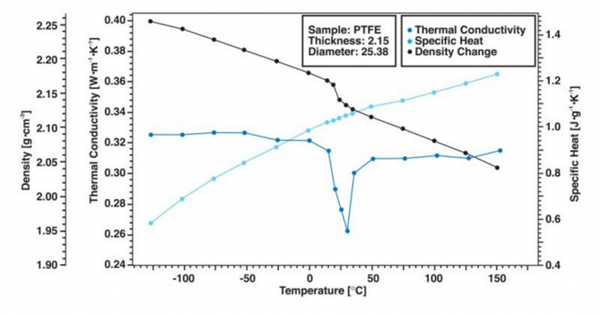
Thermal Property Analysis of PTFE
PTFE offers excellent chemical inertness and corrosion resistance and is widely used in chemical processing, petrochemical, laboratory equipment, electronics, and semiconductor industries.
Typical applications include liners, seals, gaskets, guide rails, sliders, and high-temperature insulation components.
Using the LFA 500, temperature-dependent thermal diffusivity, specific heat, and thermal conductivity can be measured to support design and reliability evaluation under harsh environments.
Thermal Conductivity, Thermal Diffusivity, and Specific Heat of Glass Ceramics
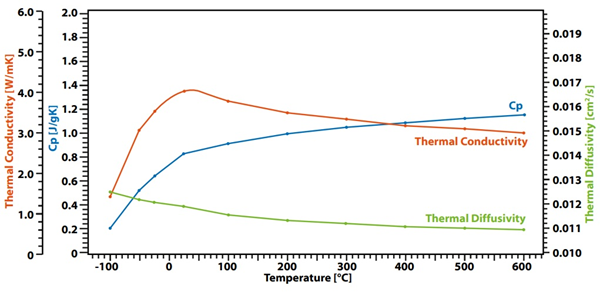
Using a standard glass-ceramic reference material (e.g., BCR 724) as an example, bulk material is machined into thin disks
with a thickness of approximately 1 mm and a diameter of 25 mm, then coated with graphite.
Thermal diffusivity is directly measured by the LFA 500, specific heat capacity (cp) is obtained by the comparative method,
and thermal conductivity is calculated using ρ·cp·α.
Results show that specific heat slightly increases with temperature, while thermal diffusivity and thermal conductivity gradually decrease.
Thermal Conductivity Measurement of Graphite
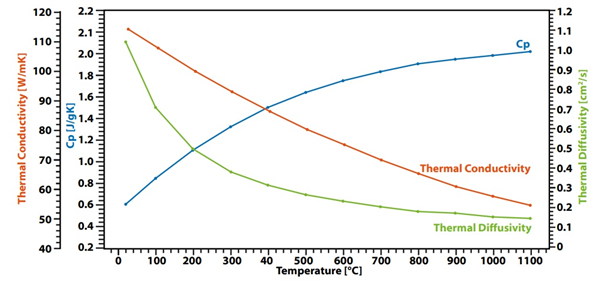
Graphite samples were tested over a temperature range from RT to 1100°C.
Thermal diffusivity curves were obtained directly, and specific heat and thermal conductivity were calculated using a graphite reference.
Results indicate that above 500°C, thermal conductivity decreases linearly with temperature, thermal diffusivity levels off,
and specific heat shows a slight increase.
Repeatability Verification of Thermal Diffusivity Measurement for Glass Ceramics
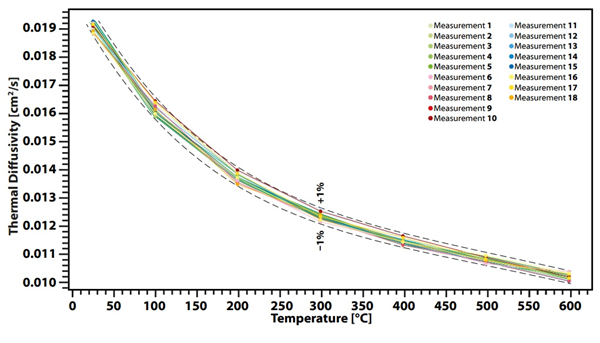
Eighteen independent tests were performed on a high-temperature ceramic reference material using 18 samples cut from different positions of the same specimen.
Within the temperature range from RT to 600°C, the measured thermal diffusivity deviation remained within ±1%,
demonstrating the excellent repeatability and stability of the LFA 500.
Technical Video
Mobile: +886-919-138-108
Email: Allen.kuo@fstintl.com.tw