

Thermal Management Challenges in High Power Density Systems
As device power density continues to increase, waste heat management, battery system safety, and thermal runaway protection in electronic packaging have become increasingly critical. Thermal management of these complex systems is not trivial and requires a deep understanding of how individual components and interface materials interact to dissipate heat effectively.
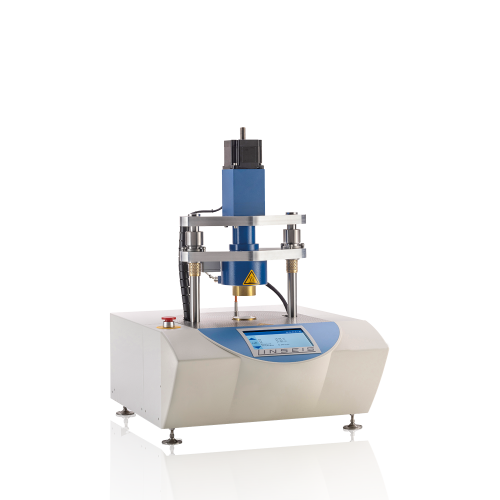
TIM Tester (Thermal Interface Material Tester)
The TIM Tester is specifically designed for measuring thermal impedance and evaluating the effective thermal conductivity of thermal interface materials. It supports a wide range of materials, including liquids, pastes, thermal pads, and rigid solid materials. The measurement method complies with ASTM D5470 and is well suited for thermal management optimization in complex systems.
Key Features
- Motorized actuator provides automatic loading (up to 10 MPa).
- High-resolution LVDT for automatic sample thickness measurement.
- Fully compliant with ASTM D5470 test methodology.
- Fully automated software control with real-time recording of measurement parameters.
- Hot-side temperature up to 300°C, supporting high-pressure and wide temperature range testing.
- Highly flexible sample holder accommodating various sample sizes and shapes.
- Typical test materials include solids, soft pads, pastes, and liquids.
- Multiple types of meter bars available, selectable according to thermal resistance and temperature range.
Measurement Principle
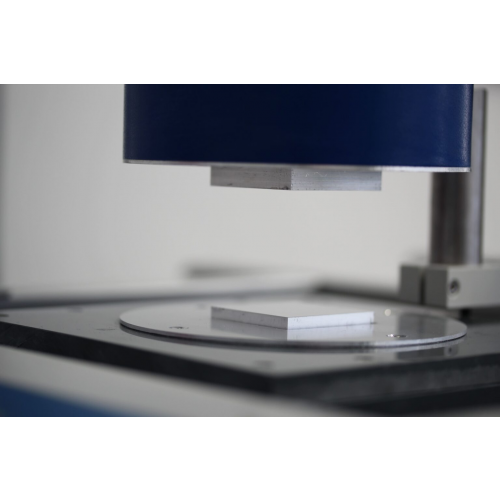
The sample is placed between a hot and a cold meter bar. The hot side is connected to a controlled heating stage, while the cold side is connected to a thermostated liquid cooling system. Contact pressure is automatically adjusted by a motorized actuator and remains stable over temperature. Sample thickness can be entered manually or measured automatically using the integrated LVDT.
Multiple temperature sensors are embedded inside the meter bars at known distances to monitor heat flux. The temperature drop across the sample is used to calculate thermal impedance. By combining the measured thermal impedance with sample thickness, the effective thermal conductivity can be determined. For multilayer structures, measurements at different thicknesses can be performed to build a linear regression model.
Technical Specifications
- Sample size: Circular Ø 20–40 mm; square 20×20 to 40×40 mm (customizable)
- Thickness range: 0.01–15 mm (extendable up to 50 mm)
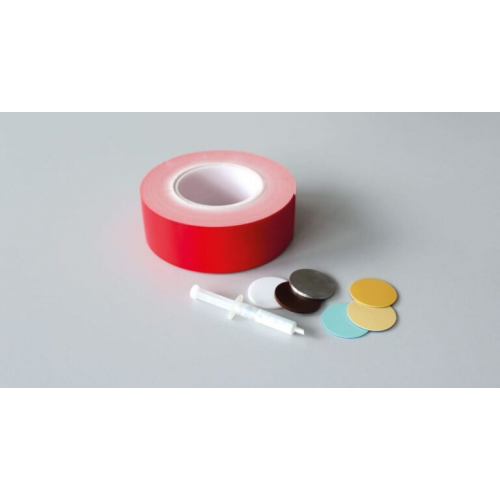
- Sample types: Solids, powders, pastes, foils, liquids, adhesives
- Thickness measurement: Integrated LVDT
- Sample thermal resistance range: 0.01–8 K/W
- Temperature range: RT to 150°C; low temperature -30°C to 150°C; high temperature up to 300°C (optional)
- Temperature resolution: 0.1°C
- Thermal conductivity range: 0.1–50 W/m·K (extendable)
- Contact pressure: Up to 10 MPa (depending on sample size)
- Instrument dimensions: 675H × 550W × 680D mm
- Cooling system: External chiller (can be combined with a heater)
- Heating system: Electrical resistance heating
* Actual specifications may vary depending on configuration
Application Example: Vespel™ Testing
At 50°C (TH = 70°C, TC = 30°C) and 1 MPa, thermal impedance and effective thermal conductivity were measured on a 25×25 mm Vespel™ sample.
Linear regression using three different sample thicknesses (1.1–3.08 mm) was applied to determine the contact thermal resistance and thermal conductivity.
.png)
Another test demonstrates the temperature-dependent behavior of the effective thermal conductivity of Vespel™
in the temperature range from 40°C to 150°C under a pressure of 1 MPa.
.png)
Thermal Pad (Type II) Testing
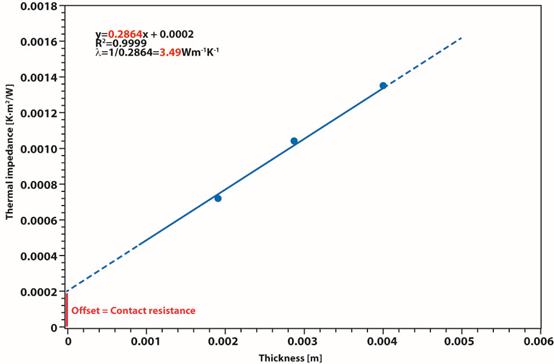
At 50°C, thermal resistance testing was performed on a 25×25 mm thermal pad (Type II).
Linear regression analysis using samples with different thicknesses (2.01–3.02 mm) was conducted to determine the contact thermal resistance.
Measurable Sample Types
Type I (Viscous Liquids)
Materials with unlimited deformation such as greases, pastes, and phase change materials, with no tendency to recover their original shape.
Type II (Viscoelastic Solids)
Materials such as gels, soft rubber, and hard rubber, exhibiting linear elastic behavior with relatively large deformation.
Type III (Elastic Solids)
Materials with negligible deformation, such as ceramics, metals, and certain plastics.
Technical Video
Mobile: +886-919-138-108
Email: Allen.kuo@fstintl.com.tw