
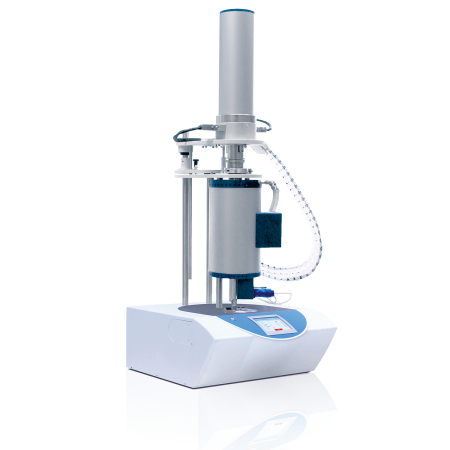
Thermomechanical Analyzer TMA 1600|High-Temperature Deformation and Thermal Property Analysis
The TMA 1600 Thermomechanical Analyzer is a high-precision TMA system specially designed for high-temperature applications. It measures material deformation behavior under the combined effects of temperature, applied force, and time. The instrument is suitable for composites, glass, ceramics, polymers, and metals, and is especially ideal for studying high-temperature phase transitions and sintering processes.
Key Features
- High-temperature capability: Supports operation from room temperature up to 1600 °C, meeting the demands of ceramic and metal high-temperature research.
- High resolution: Displacement resolution down to 0.125 nm, enabling detection of extremely small material deformation.
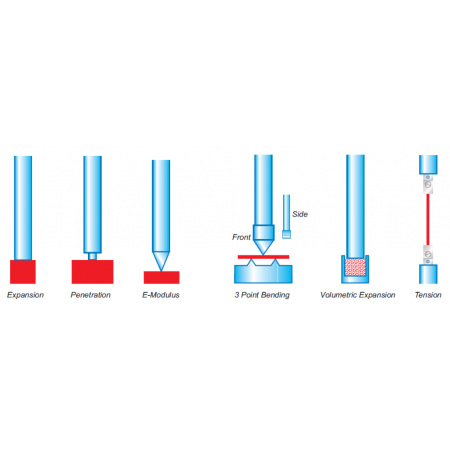
- Versatile analysis functions: Supports linear thermal expansion, dimensional change, phase transition analysis, sintering behavior observation, and softening point determination.
- Dynamic load testing: Allows different applied forces for viscoelastic material studies, such as polymers.
- Flexible sample holders: Various holders available for powders, films, fibers, and bulk samples.
- Multiple atmosphere support: Measurements can be performed under reducing, inert, oxidizing, vacuum, static, or dynamic atmospheres.
Applications
- Composite materials: Analysis of expansion, shrinkage, and structural changes at high temperatures.
- Glass and ceramics: Determination of softening point, glass transition temperature, and phase transition temperatures.
- Polymers: Study of glass transition temperature (Tg) and thermal expansion behavior.
- Metals: Measurement of thermal expansion coefficient, phase transitions, and thermal stability.
Technical Specifications
| Item | TMA 1600 |
|---|---|
| Temperature range | -150 °C to 700 °C RT to 1400 / 1600 °C (depending on furnace configuration) |
| Maximum sample size | Up to 30 mm |
| Force range | 1 / 5.7 / 20 N (optional) |
| Test frequency | 1 Hz |
| Displacement resolution | 0.125 nm |
| Available atmospheres | Reducing, inert, oxidizing, vacuum, static / dynamic |
| Standards | DIN 51005, ASTM D3386, ASTM E831, ASTM D696, ISO 11359 (Parts 1–3) |