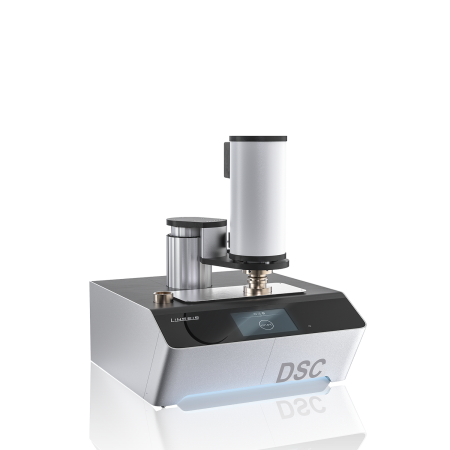
High-Temperature Differential Scanning Calorimeter DSC PT1600|Modular HDSC / DTA Thermal Analysis System
Differential Scanning Calorimetry (DSC) is one of the most widely used thermal analysis techniques. It provides comprehensive thermal property information, including phase transition temperatures, melting points, crystallization behavior, glass transition, and specific heat (Cp).
The DSC PT1600 high-temperature thermal analysis system (HDSC / DTA) features extremely high thermal sensitivity, short time constants, and a condensation-free sample chamber design, ensuring excellent resolution and baseline stability even during long-term operation. It is an essential thermal analysis tool for material development, R&D, and quality control laboratories.
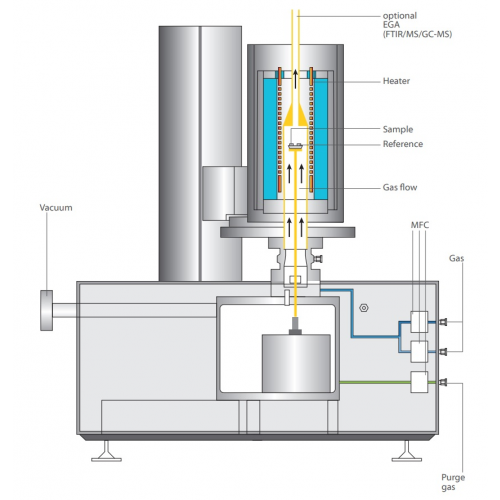
The system adopts a modular furnace design, allowing a wide temperature range from −150 °C to 1750 °C by exchanging different furnaces. The vacuum-sealed furnace enables precise enthalpy (ΔH) and specific heat (Cp) measurements under 10E-5 mbar vacuum or high-purity gas atmospheres. Optional configurations include MFC automatic gas control, an autosampler, and evolved gas analysis (EGA) coupling with MS / FTIR.
System Features and Measurement Modules
- High thermal sensitivity: Heat-flux sensor design provides extremely low noise and a stable baseline.
- Modular furnace system: Interchangeable furnaces cover temperature ranges from low temperature up to 1750 °C.
- Multiple sensor configurations: Supports DTA, DSC, and DSC-Cp measurement modes.
- Various thermocouple types: E, K, S, and B types available to meet different temperature and accuracy requirements.
- Vacuum and controlled atmospheres: Vacuum down to 10E-5 mbar; operation under reducing, oxidizing, or inert atmospheres (static or dynamic).
- Excellent expandability: Upgrade options include an autosampler, MFC gas box, and MS / FTIR coupling for EGA.
- Long-term stability: Maintains a stable baseline even at high temperatures, ideal for precise enthalpy and Cp measurements.
The DTA sensor and two different DSC sensor designs are interchangeable. Users can freely select the most suitable measurement module and thermocouple configuration according to application type, operating temperature, and atmosphere conditions.
Accessories and Software
- Crucibles: Available in various designs and materials for metals, ceramics, powders, and polymers.
- Gas control: Manual, semi-automatic, or fully automatic (MFC) gas boxes supporting up to four gases.
- Vacuum systems: Compatible with rotary and turbomolecular pumps.
- Software interface: Chinese-language interface available; measurement data can be exported as raw Excel files.
Technical Specifications
| Item | Specification |
|---|---|
| Temperature range | −150 °C to 750 °C RT to 1600 / 1750 °C |
| Thermocouple types | E, K, S, B |
| Sensor types | DTA / DSC / DSC-Cp (heat-flux type) |
| Heating rate | 0.001 to 50 K/min |
| Cooling rate | 0.001 to 50 K/min (depending on furnace and cooling configuration) |
| Atmosphere conditions | Reducing, oxidizing, inert (static / dynamic) |
| Vacuum capability | 10E-5 mbar |
| PC interface | USB |
* Achievable temperature range and cooling rate depend on the selected furnace and cooling configuration.
Typical Applications and Case Studies
Applicable materials: Inorganic materials, ceramics, metals, and alloys.
Industries: Automotive and aerospace, power generation and energy, industrial R&D and academic research, materials science, and electronics.
Case Study: Ferrite Production Process Analysis
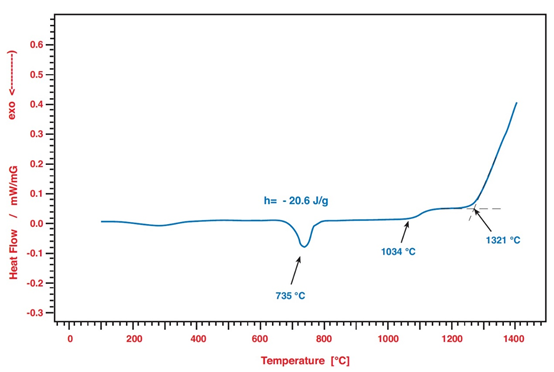
In the production of magnetic ferrites based on ZnO, Fe₂O₃, and Cr₂O₃, an exothermic structural formation peak (enthalpy change approx. −20.6 J/g) can be observed at around 735 °C, corresponding to mixed ferrite formation. Strong endothermic signals related to different phase melting behaviors are observed at approximately 1034 °C and 1321 °C. When using the DSC PT1600 equipped with an S-type sensor, a stable baseline and extremely low noise are maintained even near 1450 °C, which is critical for accurate evaluation of melting enthalpy and phase transition behavior.