
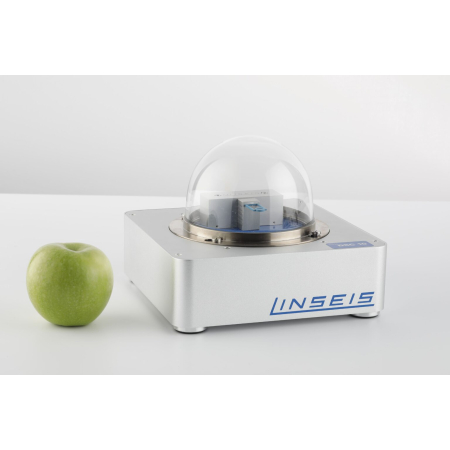
Chip-Based Differential Scanning Calorimeter|CHIP-DSC 1 & CHIP-DSC 10
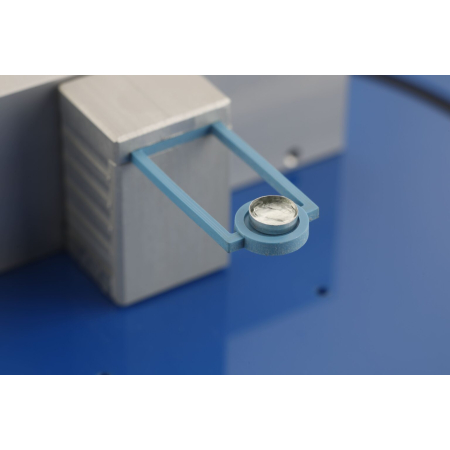
The new generation chip-based DSC (CHIP-DSC) integrates the furnace, sensor, and electronics into a compact transparent housing. Each chip sensor incorporates both a heater and a temperature sensor, mounted on a chemically inert ceramic substrate. This design provides excellent temperature control, high signal reproducibility, and fast heating/cooling performance, while significantly reducing system size and energy consumption.
The chip sensor features a low thermal mass and fast response, offering high sensitivity and excellent dynamic performance. Heating rates of up to 100 °C/min (and even higher for fast-scanning measurements) are achievable, making the system ideal for melting behavior, weak phase transitions, and rapid thermal analysis. Chip sensors are user-replaceable, resulting in low operating costs and easy maintenance.
The chip-based DSC design delivers reliable raw heat-flow data directly, without the need for additional heat-flow corrections or post-processing. The compact system architecture significantly reduces instrument cost and energy consumption, improving overall performance and return on investment.
Sensor and System Features
- Integrated chip sensor: Heater and temperature sensor are integrated into a ceramic chip, ensuring stable heat transfer and fast response.
- High sensitivity: Suitable for melting behavior analysis and detection of weak thermal transitions.
- Low-mass design: Enables excellent heating and cooling rates and increases sample throughput.
- Fast cooling capability: Ideal for repeated cycling tests and high-throughput analysis.
- Easy sensor replacement: Chip sensors can be replaced quickly at low cost to restore system operation.
- Real-time sample observation: The transparent housing allows visual monitoring of color changes, bubble formation, smoke generation, and other phenomena.
Accessories and Software Functions
- Crucibles: Available in multiple materials and sizes to match different sample requirements.
- Gas control: Compatible with manual, semi-automatic, or fully automatic (MFC) gas control boxes, supporting up to four gases.
- Vacuum systems: Compatible with various rotary and turbomolecular pump configurations.
- Software interface: Optional Chinese-language interface; supports raw data export to Excel format.
Technical Specifications|CHIP-DSC 1
| Item | CHIP-DSC 1 |
|---|---|
| Temperature range | RT to 450 °C (no cooling option) |
| Heating / cooling rate | 0.001 to 100 K/min |
| Temperature accuracy | ±0.2 K |
| Temperature precision | ±0.02 K |
| Digital resolution | 168,000 digits (pixels) |
| Heat-flow resolution | 0.03 µW |
| Atmosphere | Inert, oxidative (static / dynamic) |
| Measurement range | ±2.5 to ±250 mW |
| Calibration materials | Included |
| Recommended calibration interval | Every 6 months |
Technical Specifications|CHIP-DSC 10
| Item | CHIP-DSC 10 |
|---|---|
| Temperature range | RT to 600 °C −180 to 600 °C (with liquid nitrogen or Intracooler) |
| Heating / cooling rate | 0.001 to 300 K/min |
| Temperature accuracy | ±0.2 K |
| Temperature precision | ±0.02 K |
| Digital resolution | 168,000 digits (pixels) |
| Heat-flow resolution | 0.03 µW |
| Atmosphere | Inert, oxidative (static / dynamic) |
| Measurement range | ±2.5 to ±250 mW |
| Calibration materials | Included |
| Recommended calibration interval | Every 6 months |
Typical Application Examples
1) PET pellet analysis:
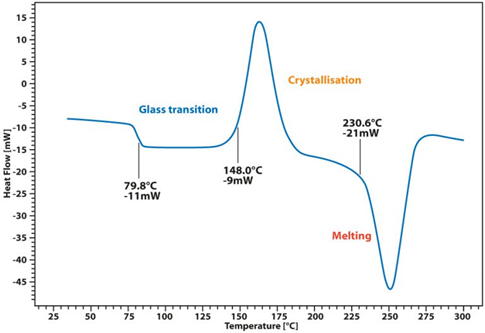
Polymer analysis is one of the main applications of DSC, focusing on glass transition temperature (Tg), melting point, and crystallization behavior.
Using high-resolution chip-based DSC with a linear heating rate of 50 K/min, PET pellets clearly show:
- ~80 °C: Glass transition (Tg)
- ~148 °C: Cold crystallization peak (amorphous to crystalline transition)
- ~230 °C: Melting peak
2) Energetic materials (e.g., airbag igniters):
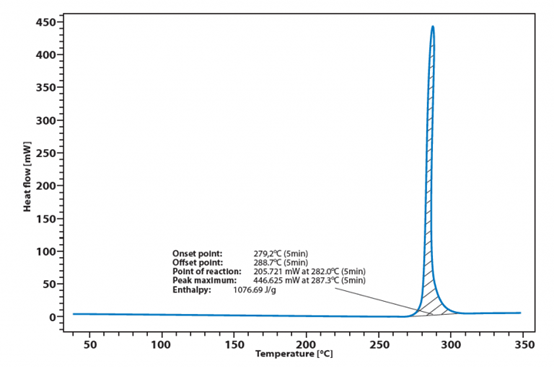
Conventional DSC measurements of energetic materials may risk damage to the sensor or furnace.
With chip-based DSC, a damaged sensor can be replaced within seconds, and recalibration completed within approximately 30 minutes,
significantly reducing downtime and maintenance costs.
3) Comparison of different heating rates:
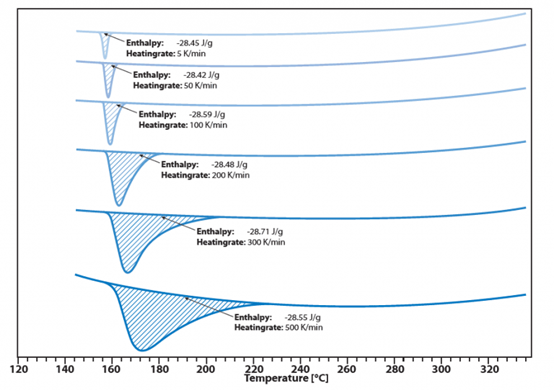
The system maintains excellent reproducibility of melting enthalpy even at high heating rates (e.g., 5, 50, 100, 200, 300, 500 K/min).
Using indium as a test material, a complete measurement (heating and cooling) can be completed in approximately 10 minutes without additional cooling devices.
4) Observation of thermochromic and visual changes:
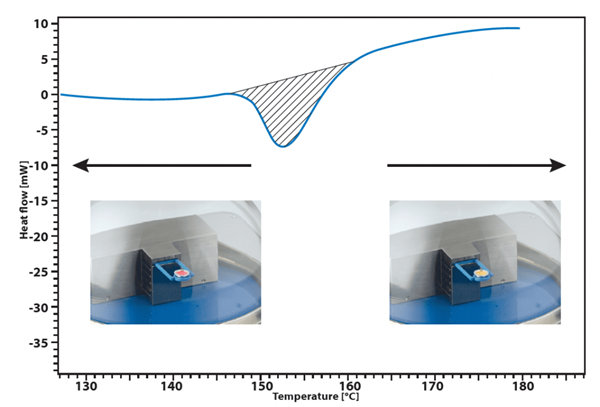
The visual design allows simultaneous observation of color changes, bubble formation, and smoke generation during DSC measurements.
This provides additional information not available from conventional DSC systems and is particularly useful for pigments, coatings, and gas-evolving samples.
Video Introduction
Watch chip-based DSC demonstration video (YouTube)