
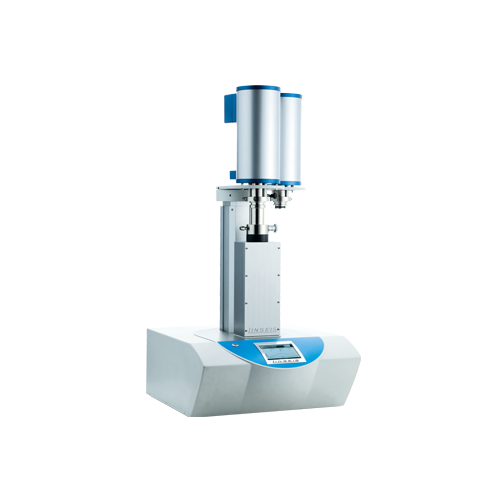
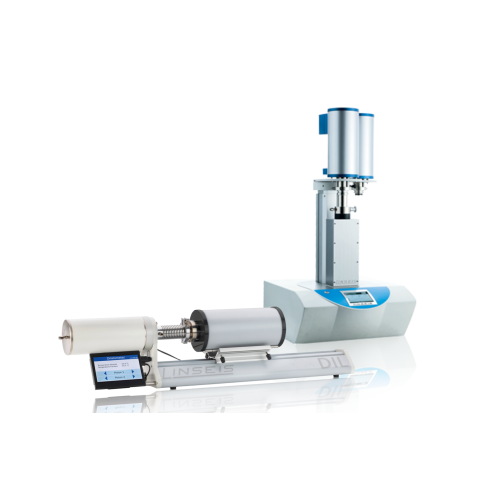
Vertical Dilatometer (DIL) | High-Sensitivity Thermal Expansion Measurement System
The vertical dilatometer offers ultra-high sensitivity and low-noise measurement performance, specifically designed for high-temperature expansion, stress behavior analysis, and advanced materials research. This system is widely used in ceramics, glass, high-performance composites, and precision process development, and is particularly suitable for high-accuracy measurements of ultra-low CTE materials.
The L75V Series adopts a unique vertical configuration combined with friction-free transmission and a vacuum-sealed system to ensure excellent measurement repeatability and environmental stability. It supports a wide range of sample types, including solids, powders, liquids, and gels, and can operate under vacuum, oxidizing, or reducing atmospheres.
Key Functions and Features
- Measurement of coefficient of thermal expansion (CTE), linear expansion, glass transition temperature, sintering temperature, and phase transitions
- Delta L resolution down to 0.03 nm, ideal for precision research and ultra-low expansion materials
- Adjustable contact force from 10 mN to 1 N, suitable for samples with different hardness and material types
- Software supports a Chinese user interface, Excel data export, real-time curve visualization, and automated test sequences
Temperature Range
- -180°C to 2800°C (depending on furnace configuration)
Optional Accessories and Software Functions
- Various sample holder designs (solid / powder / liquid / gel)
- Manual gas control or fully automated MFC-based atmosphere control system
- Rate-Controlled Sintering (RCS) module
- L-DTA (Dilatometric Differential Thermal Analysis) function
Measurable Properties
- Coefficient of thermal expansion (CTE)
- Linear thermal expansion
- Physical thermal expansion
- Sintering temperature
- Phase transition behavior
Vertical DIL vs. Horizontal DIL Comparison
| Item | Vertical DIL | Horizontal DIL |
|---|---|---|
| Load direction | Vertical downward (gravity-assisted, naturally uniform force) | Horizontal forward (mechanically applied force) |
| Force uniformity on sample | High; stable gravity direction minimizes lateral interference | May be affected by lateral friction or misalignment |
| Measurement sensitivity | Higher resolution; ideal for low-CTE materials (ceramics, glass) | Standard sensitivity; more influenced by friction |
| Sample stability | Excellent; minimal displacement during long high-temperature tests | Thermal cycling may cause slight displacement |
| Clamping method | Top-and-bottom push rod support with stable contact | Lateral clamping with less uniform pressure |
| Application advantage | High-precision research and ultra-low CTE materials | General-purpose industrial applications |
| Instrument footprint | Upright structure with greater height | Horizontal layout requiring bench space |
| Typical applications | Ceramics, glass, advanced composites, aerospace and defense | Metal processing, polymeric materials, consumer products |
Video Introduction
Watch the Vertical DIL Dilatometer Introduction Video (YouTube)
Mobile: 0919-138-108
Email: Allen.kuo@fstintl.com.tw