

Microporous Materials Adsorption Analysis System — Applications and Technical Features
Application Scope
- Surface area and pore structure analysis for microporous materials (molecular sieves, activated carbon, catalysts, etc.)
- BET specific surface area measurement (single-point / multi-point)
- Pore size distribution analysis (BJH, HK, SF methods)
- Supported adsorptive gases: N₂, Ar, Kr, H₂, O₂, CO₂, CO, NH₃, CH₄, etc.
- Materials research: ceramic powders, metal powders, carbon nanotubes (CNTs)
- Chemical engineering: carbon black, amorphous silica, zinc oxide, titanium dioxide
- New energy materials: lithium cobalt oxide, lithium manganese oxide (electrode materials)
- Catalysis: activated alumina, molecular sieves, zeolites
Measurement Principles
- Physical adsorption method: Adsorption isotherms are generated based on gas adsorption behavior on the sample surface to calculate surface area and pore structure.
- Ultra-wide pressure control: Relative pressure as low as P/P₀ = 10⁻⁸, enabling highly sensitive micropore analysis.
- Turbomolecular pump (TMP): Provides an ultra-high vacuum environment to minimize contamination and enhance measurement stability.
- Cold free space calibration: Helium (He) is used for free-space calibration to improve measurement accuracy.
Instrument Features & Benefits
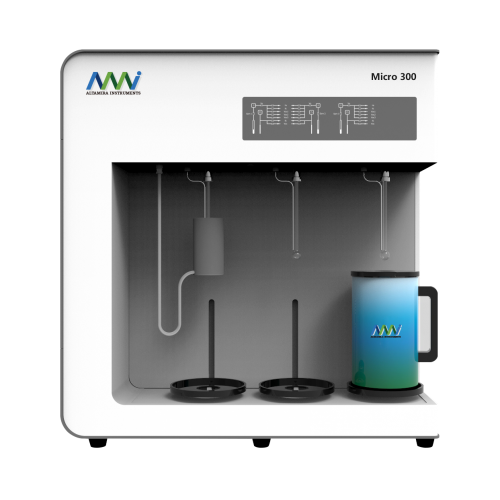
- Up to three independent analysis ports
- High-sensitivity pressure sensors (accuracy down to 0.1 Torr)
- Turbomolecular pump combined with mechanical pump, achieving ultimate vacuum down to 10⁻⁸ Pa
- In-situ degassing at each port, with maximum degassing temperature up to 400°C
- Micropore measurement precision with pore size deviation less than 0.02 nm
- Automatic liquid nitrogen level control to maintain constant sample temperature
- Supports dynamic equilibrium monitoring and remote synchronized control of multiple instruments
- Six-stage gas dosing design to improve testing efficiency
Technical Specifications
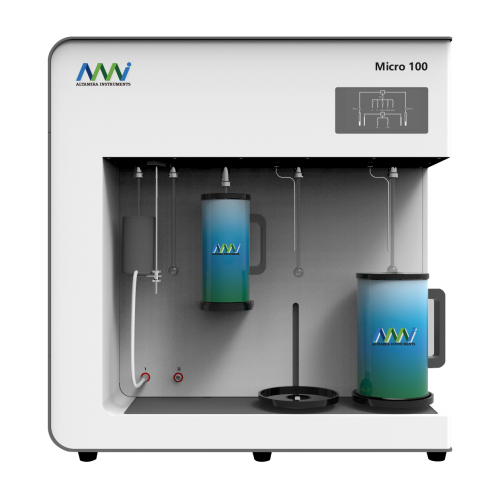
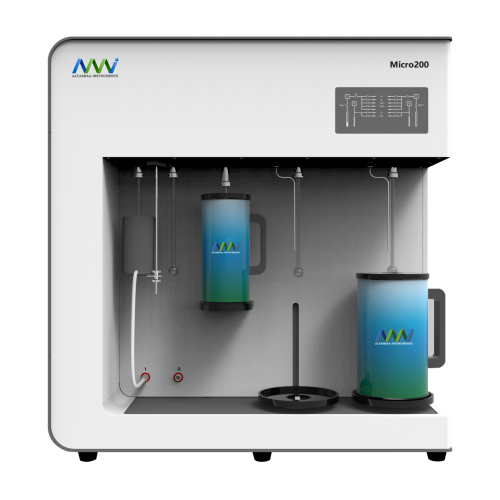
| Item | Micro100 Series | Micro200 Series | Micro300 Series |
|---|---|---|---|
| Pressure transducers | 1000 Torr | 1000 Torr, 10 Torr, 1 Torr (0.1 Torr) | 1000 Torr, 10 Torr, 1 Torr (0.1 Torr) |
| Pressure range (P/P₀) | 10⁻⁴ – 0.998 | 10⁻⁸ – 0.998 | 10⁻⁸ – 0.998 |
| Pore size measurement range | 2 – 500 nm (error ≤ 0.2 nm) | 0.35 – 500 nm (error ≤ 0.02 nm) | 0.35 – 500 nm (error ≤ 0.02 nm) |
| Minimum pore volume | 0.0001 cm³/g | 0.0001 cm³/g | 0.0001 cm³/g |
| Specific surface area range | > 0.0005 m²/g | > 0.0005 m²/g | > 0.0005 m²/g |
| Number of analysis ports | 1 | 3 | 3 |
| Degassing system | 2 degassing ports | 2 degassing ports | 3 degassing ports |
| Vacuum system | Mechanical pump, ultimate vacuum 6.7 × 10⁻² Pa | Turbomolecular pump + mechanical pump, ultimate vacuum 10⁻⁸ Pa | Turbomolecular pump + mechanical pump, ultimate vacuum 10⁻⁸ Pa |
| Analysis gases | N₂, Ar, Kr, H₂, O₂, CO₂, CO, NH₃, CH₄, etc. | ||
| Dimensions / Weight | 870 mm × 570 mm × 890 mm / 80–90 kg | ||
| Power requirements | 200–240 VAC, 50/60 Hz, max. 300 W | ||
CONTACT
Sales Contact | Lucas Lu
FST International | Microporous Material Adsorption and Pore Structure Analysis Consulting
Mobile: 0900-616-157
Email: Lucas.Lu@fstintl.com.tw