
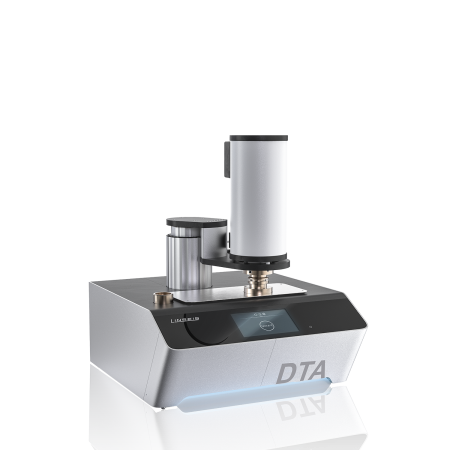
DTA PT1600|High-Sensitivity Differential Thermal Analysis System
Differential Thermal Analysis (DTA) is a widely used thermal analysis technique for materials research, development, and quality control. It is applied to detect phase transitions, melting, crystallization, glass transition, and reaction-related thermal effects, providing essential information for interpreting thermal behavior.
The DTA PT1600 system features high thermal sensitivity, an extremely short time constant, and a non-condensing sample chamber design. Even during long-term high-temperature operation, the system maintains excellent resolution and baseline stability, making it a core analytical tool for advanced materials R&D and QC laboratories.
The system adopts a modular furnace architecture. By exchanging different furnaces, a wide temperature range from -150 °C up to 1750 °C can be covered. The vacuum-tight design allows operation down to 10-5 mbar and supports inert, oxidizing, and reducing atmospheres. In addition, the system can be coupled with EGA (Evolved Gas Analysis) modules such as MS, FTIR, or GC-MS for detailed analysis of reaction gases and decomposition products.
System Features
- High-resolution DTA signals: Stable baseline and low noise, suitable for detecting weak thermal effects.
- Modular temperature zones: Coverage from -150 °C to 1750 °C depending on furnace and thermocouple configuration.
- High vacuum and high-purity atmosphere operation: Vacuum down to 10-5 mbar with inert, oxidizing, or reducing gases.
- Enthalpy and heat capacity analysis: Quantitative evaluation of phase transitions and reaction heat effects.
- Flexible sensor and crucible options: Suitable for metals, ceramics, powders, and inert materials.
- EGA integration: Compatible with MS, FTIR, and GC-MS for evolved gas analysis.
- High expandability: Optional MFC gas control units, vacuum systems, and automatic sample changers.
Accessories and Software
- Wide selection of crucibles in various materials and sizes (Pt, Al2O3, Au, quartz, etc.).
- Manual, semi-automatic, or fully automatic (MFC) gas control units, supporting up to four gases.
- Compatible with rotary vane pumps or turbomolecular vacuum systems.
- Chinese-language software interface with data export to Excel raw data format.